

Amid discussions about possible fine-tuning by financial authorities regarding stricter market capitalization criteria for listed company delisting (hereinafter "delisting"), Korea Exchange has decided to revise KOSDAQ implementation guidelines to reflect the illusion that market capitalization appears smaller when stock prices are temporarily adjusted due to rights issues or dividend distributions. This move comes amid persistent market backlash against the notion of delisting profitable companies simply because their market capitalization falls below the threshold, drawing significant attention.
According to the financial investment industry on the 31st, Korea Exchange (KRX) will revise KOSDAQ listing regulations implementation guidelines to consider cases where market capitalization fluctuates due to rights ex-dates from paid-in capital increases or bonus issues (free share issuance), or dividend ex-dates from stock dividends. KOSPI already changed its implementation guidelines with the same content on the 27th of last month.
Since July, a policy has been in effect requiring companies to maintain a market capitalization of at least 30 billion won for KOSPI and 20 billion won for KOSDAQ to avoid delisting criteria. Given that this guideline revision comes under such circumstances, it is expected that the revised implementation guidelines will be applied when determining whether to designate stocks as management-targeted or proceed with delisting due to insufficient market capitalization.
Previously, rights ex-dates or dividend ex-dates caused temporary stock price adjustments, creating an illusion that market capitalization appeared smaller. Taking bonus issue (free share issuance) rights ex-dates as an example, stock prices fell in anticipation of increased shares outstanding, but the number of shares used in market capitalization calculations had not yet increased, temporarily causing the problem of appearing to have a smaller market capitalization.
Assuming a listed company with 10 thousand won shares at 20,000 won per share and a total market capitalization of 20 billion won conducts a bonus issue (free share issuance) of one new share for every existing share, an additional 10 thousand won new shares will be issued, potentially adjusting the stock price to 10,000 won. Consequently, until the new shares are issued, market capitalization may temporarily drop by half.
This is fatal for listed companies hovering around delisting thresholds. This is why related implementation guidelines were revised. A exchange official stated, "Since KOSPI implementation guidelines with identical content have already been implemented, we expect KOSDAQ standards to be changed in early September."
The exchange's move draws attention as it aligns with the financial authorities' institutional direction of finding it difficult to change delisting policies outright but considering fine-tuning.
On the 24th, Financial Services Commission Chairman Lee Eoung-won responded to market concerns that strengthening market capitalization criteria could make even profitable companies targets for delisting, stating, "Considering the credibility of currently applied policies, a comprehensive policy change is not easy, but we will examine whether there are areas for fine-tuning."
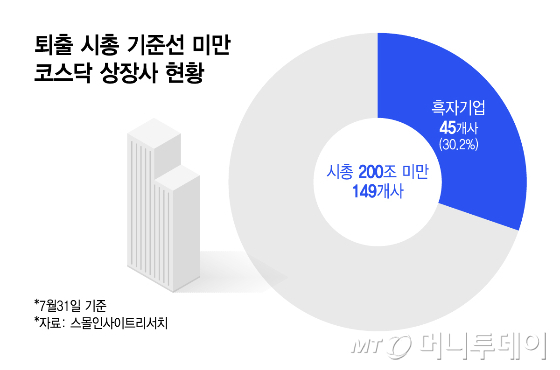
In fact, according to data released by Democratic Party of Korea lawmaker Kim Hyun-jeong on that day, as of late July, among 149 KOSDAQ companies with market capitalization below 20 billion won, 45 were profitable. With the National Assembly calling for supplementary measures and financial authorities promising fine-tuning, it is highly likely that adjustments in forms such as exchange guideline revisions will continue to follow.
However, some view that the impact on the market will not be significant because companies near delisting thresholds will find it difficult to secure the capacity to conduct capital increases or distribute dividends.
A securities industry official stated, "Opinions are being raised that supplementary procedures must be substantially established to verify a company's continuity, including its business foundation and recovery prospects," adding, "Policies should not send signals that short-term stock prices and market capitalization management are more important than innovation in the market."

 in STOCK
