

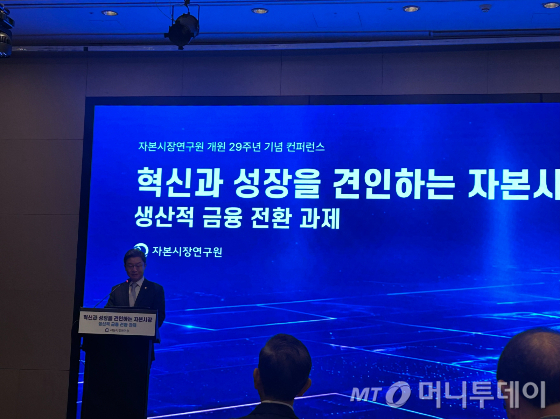
"We will strengthen the long-term and stable supply-demand foundation of the domestic stock market. To achieve this, long-term funds linked to asset formation by citizens—not short-term trading or margin investing (investing with debt)—must serve as a pillar of the market."
Lee Eog-weon, chairman of the FSC, made these remarks at the conference held on the 18th at Conrad Hotel in Seoul Yeouido to mark the 29th anniversary of the Korea Development Institute for Capital Markets. The theme was "Capital Market-Driven Innovation and Growth: Transitioning to Productive Finance." Through his speech, he announced four plans by the FSC to facilitate the transition to productive finance.
Lee stated regarding long-term funds, "We will work with relevant ministries to review financial tax policies that reward longer holding periods with greater benefits, and we will refine products and systems—including launching our own independent fund and productive ISA accounts—to make long-term investment a rational choice."
He also expressed his determination to spread shareholder-friendly corporate governance reforms. Lee emphasized, "We will ensure the three revised Commercial Acts take root by monitoring for loopholes or indirect signals of evasion, and we will block the neglect of undervaluation centered on controlling shareholders and stock price suppression through the publication of a low PBR risk list. We will also promote market oversight by encouraging institutional investors' shareholder engagement and actively support corporate shareholder returns, including expanded dividends."
Regarding KOSDAQ, where the supply-demand foundation is relatively weak, he stated his strong intention to vigorously push for market restructuring and expansion of investment funds. Lee said, "We will create a market where promising companies grow, distressed companies exit, and high-quality companies are treated fairly. We will also foster an environment where long-term capital from institutional investors, such as the National Pension Service, flows into the market."
To this end, plans are in place to establish a KOSDAQ venture fund within the National Growth Fund and begin investments by October. Additionally, "Korea Strategic Technology Partners," a specialized asset management company focused on future strategic technologies and ultra-long-term large-scale investments, will be established to supply funds to core source technology sectors. The government also intends to parallel efforts to expand investments into secondary markets where unlisted companies operate, supporting their growth before entering the KOSDAQ market.
He emphasized strict measures against market-disturbing activities such as stock price manipulation. Lee stated, "We will closely manage stock market leverage, including credit financing. We will also prepare more detailed volatility mitigation mechanisms, such as the Financial Services Commission's role in ensuring market stability during emergencies and introducing emergency action powers."
The background of these plans lies in the so-called "Roller KOSPI." Lee noted, "KOSPI, which had been trapped in a trading range, has achieved the highest growth rate among major countries since the current government took office. Its global standing has also risen, with its market capitalization ranking climbing from 13th to 8th."
He added, "With three revisions of the Commercial Act and the launch of a joint task force against stock price manipulation, market rules have been established, and companies have shown shareholder-friendly behaviors such as increasing dividends and expanding treasury share cancellations."
However, he diagnosed that rapid growth also brought shadows. In June and July last year, factors such as sector-specific concentration, investment expansion through borrowing, and FOMO (fear of missing out) combined to increase volatility, causing the stock market to undergo significant corrections.
Lee stated, "While this period has been meaningful in confirming our market's potential, we feel a heavy responsibility to ensure these expectations remain unwavering. Challenging tasks lie ahead for us, including the sharp rise in international oil prices triggered by the Middle East conflict, global pressure from rising interest rates, and global uncertainties surrounding AI (artificial intelligence) semiconductor industry conditions."
He further clarified, "The government will accelerate its consistent efforts to improve the capital market's fundamentals, expand stock market dynamism, resolve accumulated anxieties, and strengthen the market's internal stability."

 in STOCK
