

With AI (artificial intelligence) momentum reviving, semiconductor materials, components and equipment stocks and board stocks surged in the KOSPI market during the fourth week of September (September 21–25). With the domestic stock market closed for the Chuseok holiday starting from the 24th, attention is focused on whether this trend will continue.
According to data from Korea Exchange on the 26th, the KOSPI closed at 7,080.92, up 186.69 points (2.71%) from Jeonju's level of 6,894.23. The index rose primarily driven by semiconductor stocks amid successful launches of Meta's new agent AI and expectations that memory semiconductors and MLCCs (multilayer ceramic capacitors) will remain in tight supply next year.
During this period, leading semiconductor stocks Samsung Electronics and SK Hynix rose 9.39% and 0.27%, respectively. The leading board stock, Samsung Electro-Mechanics, gained 8.57%.
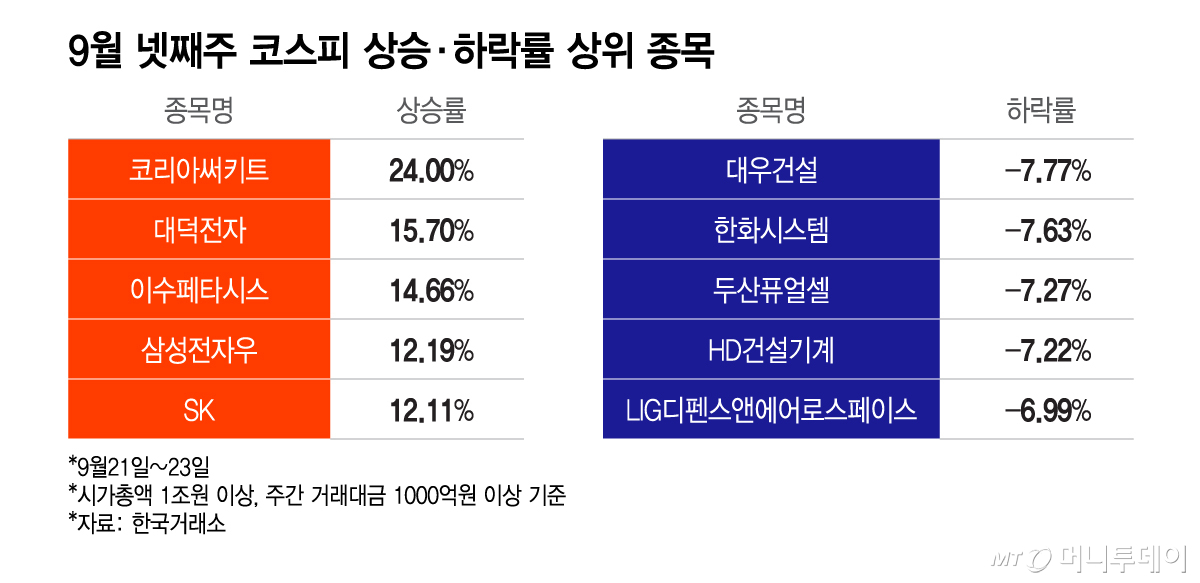
Materials, components and equipment stocks outperformed the leaders. Among KOSPI-listed companies (with market capitalization of at least 1 trillion won and weekly trading volume exceeding 100 billion won), the biggest gainer was board stock Korea Circuit, which surged 24%. Another board stock, Daejeon Electronics, also rose 15.7%.
Expectations are growing that prices will rise in the future as MLCC supply shortages intensify. Go Ui-young, a researcher at iM Securities, stated, "The shortage of high-capacity MLCCs observed last month has spread to general-purpose MLCCs this month, and distribution prices for some items have surged by 280% within just one month." He added, "This is indirect evidence that production capacity allocation toward server-grade products is putting pressure on the MLCC supply-demand environment."
Semiconductor materials, components and equipment stock LSI Petasis also jumped 14.66%, ranking among the top gainers. Other stocks that rose included DB HiTek (up 4.68%) and Hanmi Semiconductor (up 3.18%).
The spotlight on semiconductor materials, components and equipment stocks stems from domestic and foreign semiconductor companies beginning expansion projects. While leading semiconductor firms saw significant earnings growth from last year through the first half of this year, analysts expect performance growth for semiconductor materials, components and equipment firms starting in the second half of this year.
Kim Rok-ho, a researcher at Hana Securities, said, "We believe there are many investment opportunities across the materials, components and equipment sector." He added, "Considering the expansion schedules of domestic and foreign semiconductor companies, visibility for growth through 2028 is very high."
On the other hand, nuclear power stocks and defense stocks mostly declined during this period. Funds flowed into semiconductor stocks, and as investors adopted a wait-and-see stance ahead of the Chuseok holiday, profit-taking orders emerged primarily among stocks that had risen significantly.
Notably, nuclear power stocks and construction stocks that had risen on momentum from agreements related to U.S.-related investment projects fell after those announcements were delayed. Daewoo E&C (-7.77%) and HD Hyundai Heavy Industries Construction Machinery (-7.22%) ranked among the biggest decliners.
Defense stocks, which had risen on expectations of cooperation with the Middle East, declined due to profit-taking and reduced risks from the Middle East conflict. Hanwha Systems and LIG Defense & Aerospace fell 7.63% and 6.99%, respectively. However, securities firms still advised investors to pay attention to defense stocks.
Lee Dong-heon, a research fellow at Shinhan Investment Corp., stated, "There is no reason to view de-escalation as negative for the defense sector." He explained, "Decisions on weapon imports in the Middle East that were postponed due to war are resuming, and the U.S. has consumed a significant portion of its interceptor missiles, leading to accumulated medium-to-long-term replenishment demand." He further added, "The net effect of the war will ultimately lead to increased weapons demand," and concluded, "We maintain our overweight investment recommendation."

 in STOCK
