

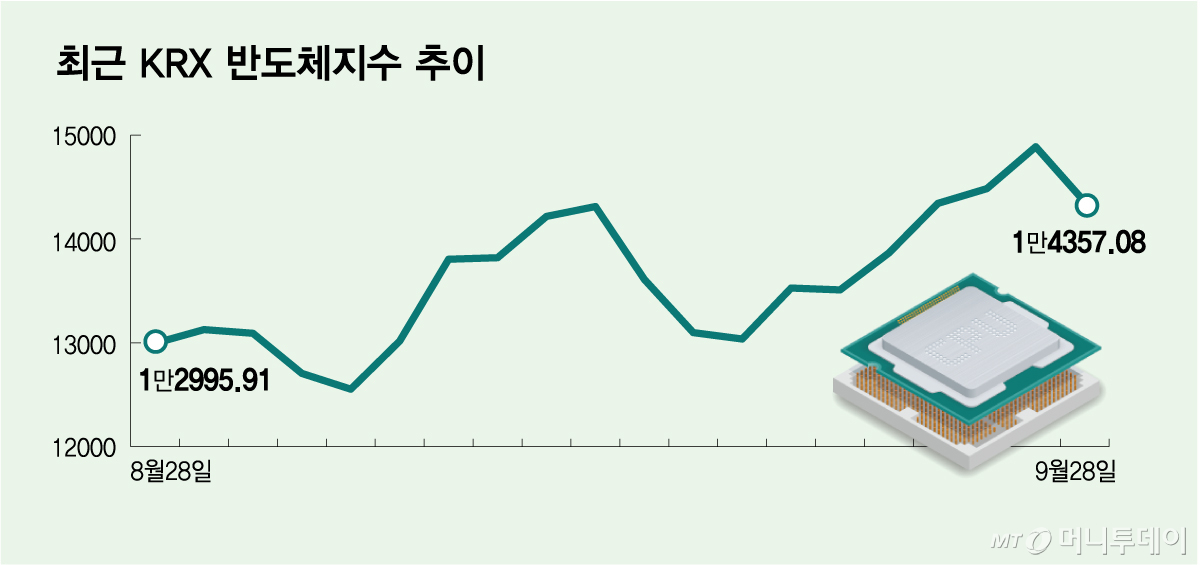
Following the volatile market conditions in July, the domestic stock market, which had exhibited rotation patterns, is now shifting its weight back toward semiconductors. Indices related to Jo-Bang-Won (shipbuilding, defense, nuclear power) and Cha-Hwa-Jeong (automobiles, chemicals, refining), once symbols of rotation trading, have weakened compared to last month, while semiconductor-related indices are rising again. With renewed expansion in AI (artificial intelligence) investments and growing expectations for earnings growth, investor sentiment (hereafter referred to as "sentiment") is moving toward semiconductors.
According to data from the Korea Exchange (KRX) on the 28th, the KRX Shipbuilding TOP10 Index, which includes major shipbuilders such as HD Hyundai Heavy Industries, Hanwha Ocean, and Samsung Heavy Industries, closed at 4,598.84, up 0.06% from the previous trading day. Although it rose slightly, the index, which had climbed to the 5,300 range in August after hitting its worst volatility at the end of July, has now fallen back to the 4,600 range in September.
The KRX K-AI Defense TOP4+ Index has dropped from around 13,000 to approximately 11,000 recently, and the KRX Automobile Index, which had exceeded 3,100 in early August, has also declined to the 2,500 range.
Jo-Bang-Won, once a symbol of non-semiconductor rotation trading, and Cha-Hwa-Jeong, traditional cyclical-sensitive stocks, served as key support for the domestic stock market in August despite the emergence of AI and semiconductor bubble theories and rising oil prices due to geopolitical risks.
In fact, during August, the KOSPI ADR (Advance-Decline Ratio) fluctuated between 100% and 140%. The ADR is an indicator showing the ratio of advancing stocks to declining stocks, reflecting whether buying or selling pressure is concentrated. An ADR of 100% indicates a balance between advancing and declining stocks; above 120% suggests overbought conditions, while below 70% indicates oversold conditions.
Not only in the KOSPI, which was led by Jo-Bang-Won, but also in the KOSDAQ, where secondary battery and biotech stocks gained strength, rotation trends were detected across both markets based on ADR readings.
However, recent KOSPI and KOSDAQ ADRs have fallen to around 80%, nearing oversold territory. This indicates that concentration in specific stocks has intensified compared to August. By sector, shipbuilding orders at high prices and expectations for earnings improvements appear to have already been largely priced into stock values, while defense stocks seem to face increased profit-taking pressure. Automobiles, despite solid earnings, are assessed as having relatively weaker profit growth momentum compared to semiconductors.
Accordingly, experts analyze that investor sentiment is shifting back to the market-leading semiconductor sector. A securities industry official stated, "Ultimately, market interest is moving from searching for the next leading stock through rotation trading to sectors with confirmed earnings."
The KRX Semiconductor Index, which had fallen to the 9,800 range at the end of July and remained in the 12,000–13,000 range throughout August, has recently surged to the mid-14,000 range. This marks a recovery to levels seen before the launch of single-stock leverage ETFs (exchange-traded funds) that shook the domestic market at the end of May.
Persistent high expectations for earnings growth are once again drawing investor sentiment toward semiconductors. Lee Kyung-min, FICC Division Head at Daishin Securities, said, "As we enter the pre-earnings season for the third quarter, earnings reports from Micron and Samsung Electronics will be released. Once the September export data announced on October 1 confirms industry conditions, earnings, and fundamentals across key sectors including semiconductors, it will provide the strength to withstand upward pressure on interest rates."

 in STOCK
