

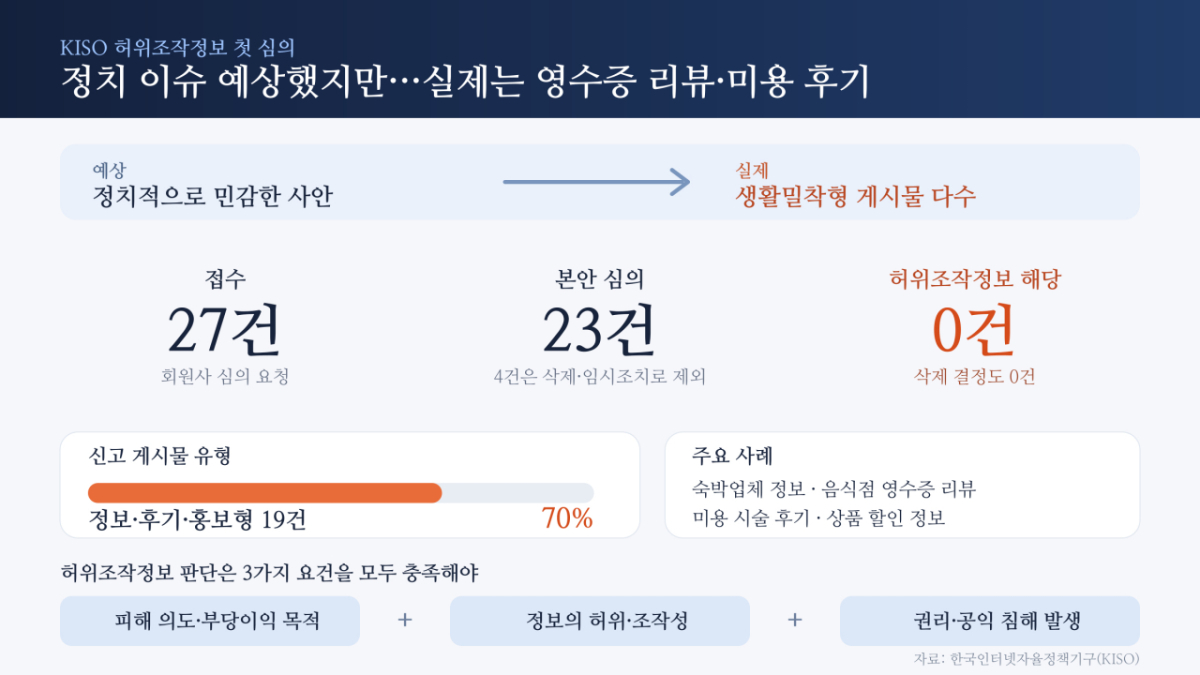
Contrary to expectations that politically sensitive fabricated information would dominate, KISO’s (Korea Internet Self-Regulatory Organization) first review primarily included restaurant receipt reviews, beauty treatment testimonials, and promotional posts from accommodation providers. All 23 posts that underwent final review were concluded not to be fabricated information.
The KISO Special Committee on Fabricated Information Review held a press conference on the 2nd, publicly disclosing the status of fabricated information reviews for the first time since the revised Information and Communications Network Act took effect. When member companies such as Naver (NAVER) and Kakao encounter cases difficult to judge independently, they refer them to the committee, where experts from legal, media, journalism, and technology fields conduct the review.
Of the 27th posts received, 19 were categorized as 'Information/Testimonial/Promotion Type,' accounting for 70% of the total. These included information on travel and accommodation providers, restaurant receipt reviews, beauty treatment testimonials, and product discount information. Posts that used hotel lobby photos while introducing guesthouses or promoted certain substances as beneficial to health also became review targets.
Kim Min-ho, chairperson of the Special Committee, stated, "Initially, we expected that most of the first agenda items would involve politically sensitive issues once the system was implemented," adding, "However, the actual reported cases were completely different from our expectations."
The committee conducted final reviews on 23 posts, excluding four that were deleted during the review process or temporarily restricted due to reasons such as defamation. All 23 posts were determined not to constitute fabricated information under the 'KISO Fabricated Information Self-Regulatory Guidelines.' There were no cases where the committee decided to delete content based on fabricated information grounds.
Under the law, for information to be recognized as fabricated, it must have the intent to cause harm to others or gain unfair benefits, and the information itself must be false or manipulated. Additionally, it must result in damage to an individual's personality rights, property rights, or public interest.
Kim Hyun-kyung, a professor of IT policy at Seoul National University of Science and Technology (SeoulTech), explained, "Content is not subject to distribution bans solely because it is false or manipulated," noting, "Since prohibiting even everyday statements made without any intent would be unreasonable, the law sets conditions based on purpose and actual harm."
KISO interprets the legal phrase 'anyone' to include not only those who initially create false information but also those who disseminate it. However, the committee strictly assesses whether there was an intent to cause harm to the poster. Factors considered include the content of the post, its creation context, the relationship with the victim, repetition, scope and method of dissemination, among others.
Repeatedly posting content targeting specific individuals or intentionally removing or altering indicators that could verify sources may be deemed as having an intent to cause harm. Other judgment criteria include whether the information was spread systematically using botnets or macros, and whether the poster refused deletion requests from victims while continuing to disseminate the content.
Even if certain expressions are inaccurate or the information is outdated, it will not be classified as false or manipulated if the core content of the post does not reasonably mislead users' judgment. Personal evaluations, opinions, and academic/scientific/religious disputes where truth has not yet been clarified are also excluded from review targets.
Kim Hyun-kyung emphasized that not all inaccurate information or posts involving rights violations are classified as fabricated information. He stated, "We will publicly disclose future review cases and results to enhance the predictability and credibility of self-regulation."

 in TECH
