

The government's initiative to nurture the physical AI industry is gaining momentum, moving beyond collaboration between different types of robots and facilities to integrate entire factories into a single system through 'factory orchestration.'
The Ministry of Science and ICT held a kick-off meeting for its Physical AI R&D project on the 16th at Seoul's Novotel Ambassador Hotel. It announced plans to establish a Jeonju-based Physical AI research and development framework centered on manufacturing sites in North Jeolla Special Self-Governing Province and South Gyeongsang Province.
The event was attended by approximately 200 participants, including Lee Do-gyu, Director of the Information and Communications Policy Office at the Ministry of Science and ICT; National Assembly members Jung Dong-young and Choi Hyung-du; Jeonbuk Vice Governor for Economy Go Jeong-sam; Gyeongnam Vice Governor for Economy Choi Man-rim; as well as researchers from institutions, universities, companies, and related organizations.
This kick-off meeting is significant for officially launching a virtuous cycle structure of 'technology development → on-site validation → data and learning → reapplication → expansion.' It aims to pool domestic research capabilities at the highest level in academia, industry, and government to apply laboratory technologies to actual manufacturing sites and utilize data collected from these sites to further enhance AI models and operational systems.
First, Jeonbuk will promote the development and validation of core physical AI technologies specialized for manufacturing and logistics sites through the project 'Research and Development of Collaborative Intelligence Physical AI-based SW Platform and Ecosystem Creation.'
From this year until 2030, a total investment of 736.8 billion won will be made over five years to develop a physical AI software (SW) platform enabling collaboration between different robots and facilities, which will then be validated in actual manufacturing sites.
Through this project, the Ministry of Science and ICT aims to go beyond collaborating heterogeneous robots and facilities to challenge 'factory orchestration,' integrating entire factories into a single system. This includes connecting factory layout and logistics robot route automatic design, 3D digital twin-based virtual validation, vision-language model (VLM)-based situational awareness, and reinforcement learning-based integrated control to actual testbeds and on-site validations.
Building on on-site application results confirmed during last year's PoC (Proof of Concept), the plan is to secure a general-purpose dark factory model that designs, constructs, and operates factories using AI, and to develop it into an exportable K-manufacturing factory model with standardization and interoperability capabilities alongside anchor companies in each industry.
In Gyeongnam, the project 'Development and Global Validation of Human-AI Collaborative LAM (Large Action Model)' will develop 'precision control specialized physical AI technology' that enables humans and AI to collaborate and allows AI to perform actual tasks.
With a manufacturing foundation comprising key industries such as defense, shipbuilding, and machinery, along with 210 industrial complexes, Gyeongnam will invest a total of 676.3 billion won over five years from this year until 2030 to secure high-quality manufacturing data. The core technology, LAM, involves developing AI models capable of actual actions and precision control based on data combining worker and robot behaviors in manufacturing sites with physical laws and spatial information. Additionally, a cyclic system will be established linking digital twins and data pipelines from learning through on-site deployment to relearning of results.
By next year, the project aims to secure representative manufacturing process data, core data pipelines, bidirectional digital twins, minimum viable product (MVP) prototypes of platforms, and major validation systems. By 2030, it will pursue integrated validation targeting more than 13 manufacturing processes, establishing on-site digital twins and virtual manufacturing factories (FAB), with goals of achieving over 90% closed-loop automation rates and reflecting relearning within 24 hours.
Meanwhile, this project involves approximately 3,500 researchers from over 150 universities, research institutions, and companies at the highest domestic level. Small and mid-sized enterprises account for 107 companies, representing about 68% of participants.
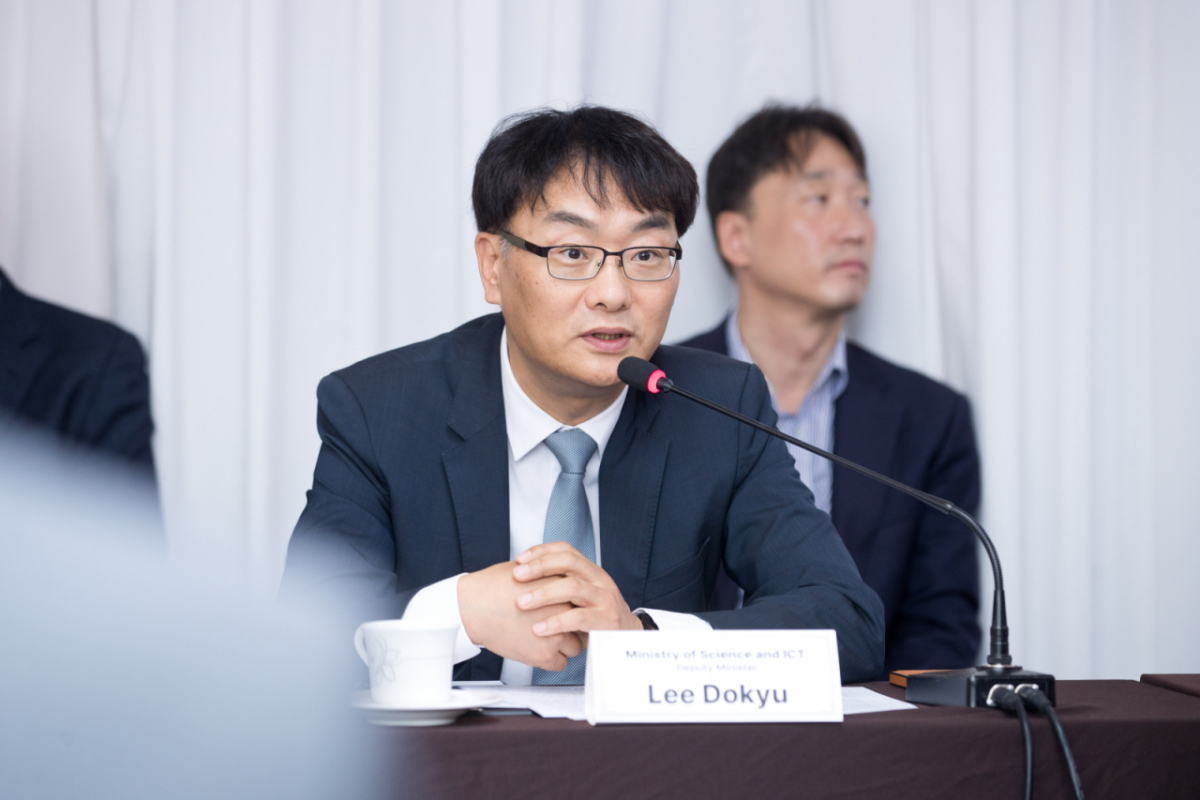
Lee Do-gyu, Director of the Information and Communications Policy Office at the Ministry of Science and ICT, stated, "We will actively support the expansion of technology development and on-site validation results starting from Jeonbuk and Gyeongnam to manufacturing sites nationwide, enabling the export of South Korea's 'K-manufacturing factories' to global markets."

 in TECH
