

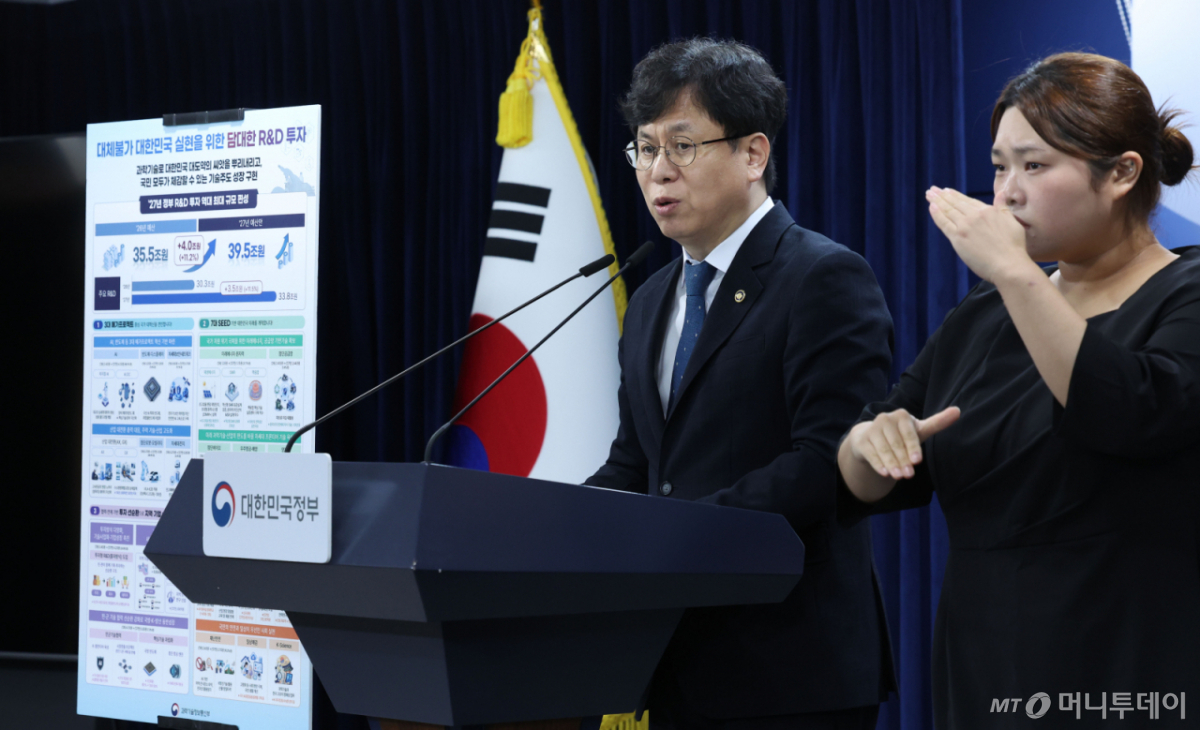
The Ministry of Science and ICT discussed ways to improve the system with 19 universities and the country's four major institutes of science and technology as the evaluation system for national R&D projects and criteria for distributing research incentives are set to change next y
The ministry said Friday that it held a meeting at Gwanghwamun chaired by Park In-kyu, Minister of Science and ICT, with heads of university-industry cooperation offices nationwide, executives of the Yeon Gu (Director) Council, and officials from the four major science institutes.
This meeting was convened to directly explain the key contents of the '2026 National R&D Administrative System Improvement Plan,' which was approved at the deliberation session of the National Science and Technology Advisory Council on the 26th last month, and to gather feedback from the research field accordingly.
Under the implementation of the administrative system improvement plan, changes will take effect starting in 2027 regarding: △project evaluation systems, △criteria for distributing research allowances, △standards for settling R&D funds, and △research security frameworks.
The project evaluation system will shift from a current grade- and score-based system focused on results to one that selects outstanding projects and provides incentives. Projects with unreliable execution processes, such as violations of laws and regulations, failure to fulfill contractual obligations, or research misconduct, will be classified as 'inappropriate projects' and subject to strong penalties, including recovery of research funds and restrictions on participation in projects.
Additionally, the moving target system, which allows researchers to flexibly adjust their goals during the course of a project, will be fully implemented next year. Processing procedures for rapidly changing research goals will be significantly shortened, and cross-ministerial guidelines for approval will adopt a negative approach described as 'everything is allowed except what is explicitly prohibited.'
Furthermore, measures will be taken to prevent research allowances from being excessively concentrated on a single researcher. In addition to the current 'total repayment' rule, which limits an individual's share of research allowances to no more than 20% of total personnel costs, and the 'distribution cap,' which restricts it to no more than 70% of the total research allowance amount, a new individual cap will be added: 'within 100% of the allocated personnel cost for each project.'
The Ministry of Science and ICT stated, "There may be a misunderstanding that researchers' compensation will decrease under the revised research allowance system, but the total amount of research allowances paid will not decline." It further explained, "By eliminating the concentration of research allowances, the payment amounts for researchers such as postdoctoral fellows and non-tenure-track faculty members participating in the same project will increase."
Park In-kyu, head of the Innovation Headquarters, said, "We will faithfully incorporate the opinions heard during today's meeting into the process of developing detailed measures."

 in TECH
