

With the surge in power consumption at AI (artificial intelligence) data centers, 800V DC (800-volt direct current), which can reduce power loss and facility space, is gaining attention as a next-generation power supply technology. As the power system evolves, demand for high-voltage components and distribution equipment is also expected to grow, opening new business opportunities for domestic companies.
According to industry sources on the 20th, NVIDIA announced the open design of its next-generation AI platform, 'Vera Rubin,' at the 'OCP (Open Compute Project) Global Summit 2026' held in San Jose, California, from the 12th to the 15th, and moved to expand the 800V DC power ecosystem. It also introduced 'K-1,' a next-generation AI factory platform designed by partner VisionBuy based on 800V DC.
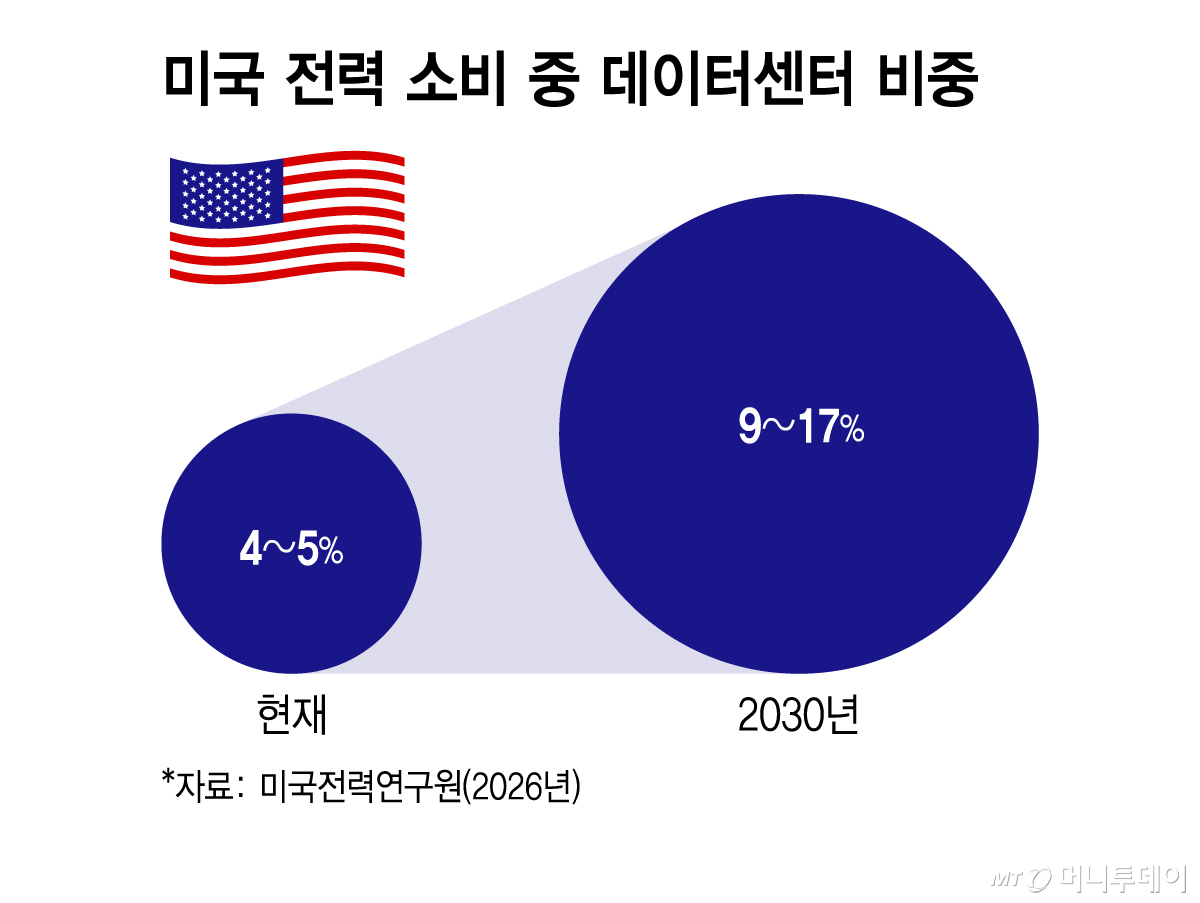
The 800V DC system is emerging as power consumption for AI servers surges. As the performance of AI accelerators improves and the number of semiconductors installed in servers increases, it is predicted that power consumption per rack in next-generation AI data centers will reach the MW (megawatt) level. According to the U.S. Electric Power Research Institute, the share of data centers in total U.S. electricity consumption is expected to rise from the current 4–5% to a maximum of 17% by 2030.
Currently, AI data centers primarily supply AC (alternating current) power to server racks and then convert it back to DC for use. In fact, according to NVIDIA, data centers typically receive AC transmission at 13.8–35kV, step it down to 415V AC through multiple stages before supplying it to server racks, and then convert it to 54V DC within the racks.
In contrast, the 800V DC system involves converting the received AC power to 800V DC inside the data center and then supplying it directly to the server racks. The industry expects the adoption of 800V DC to begin gradually next year and to become full-scale from 2028.
The advantage of 800V DC is that it simplifies the power supply process while reducing wiring burden and power loss. NVIDIA estimates that using the same cables, it can transmit 157% more power than the existing system. It also judges that the space occupied by power conversion devices can be reduced, making it advantageous for installing more AI servers in the same area.
If the power supply system changes, related components and equipment must also change. To stably supply high-voltage DC, power conversion devices, capacitors, circuit breakers, and other components capable of withstanding high voltage are required.
Samsung Electro-Mechanics is developing high-voltage-resistant MLCCs (multilayer ceramic capacitors) to respond to the spread of 800V DC. In July last month, it unveiled a 1000V-rated MLCC corresponding to the 800V DC power system. MLCCs are core components that reduce voltage fluctuations and noise and stabilize power supply.
LS Electric is also moving to target the 800V DC power infrastructure market. In cooperation with LG Uplus, it is jointly verifying the performance, safety, and operational efficiency of an 800V DC power supply system to be applied to next-generation AI data centers. In July last month, it built a 'DC Factory' at its Cheonan facility in Chungnam Province, applying DC-dedicated equipment such as semiconductor transformers (SST), semiconductor circuit breakers (SSCB), and energy storage systems (ESS).
It is also good news for other power equipment companies. Hyosung Heavy Industries is developing SST technology that integrates transformation and power conversion functions using power semiconductors. HD Hyundai Electric is also responding to the expansion of the AI data center market based on its existing power equipment businesses, including transformers, switchgear, and circuit breakers.
An industry official said, "Transitioning to 800V DC allows for more efficient supply of the power required by high-performance AI servers, so NVIDIA is leading the shift in the power system centered on its partners." The official added, "However, due to challenges such as integration with existing AC facilities, safety verification, and standardization, the actual adoption speed may be slower than expected."

 in INDUSTRY
