

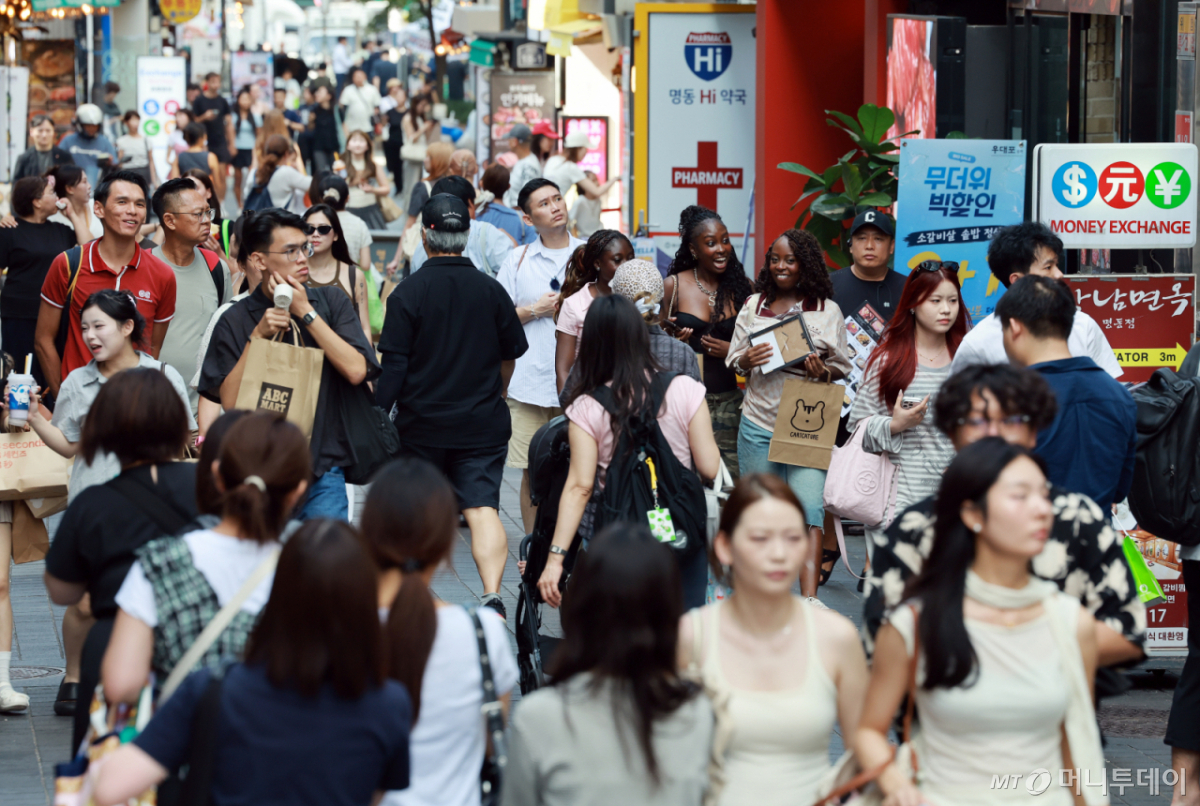
In the second quarter of this year, the amount spent by South Koreans on cards overseas decreased by more than 4% compared to the previous quarter. While direct purchases made abroad increased, a sharp decline in the number of domestic travelers caused a contraction in travel-related spending. In contrast, the amount spent by foreigners on cards within Korea surged by 36%, shattering the all-time record.
According to the 'Card Overseas Usage Performance by Residents in Q2 2026' released by the Bank of Korea on the 2nd, the overseas usage amount for credit and debit cards by residents in the second quarter was $5.85 billion, a 4.2% decrease from the previous quarter ($6.1 billion). Compared to the same period last year ($5.52 billion), it increased by 5.9%.
The decline in overseas card spending was influenced by a drop in outbound travelers. The number of domestic residents traveling abroad in the second quarter fell to 6.631 million, a 20.4% decrease from the previous quarter. Although online shopping direct purchases made abroad increased by 4.3%, rising from $1.35 billion to $1.41 billion during the same period, this was not enough to offset the decline in travel-related spending.
By card type, both credit and debit card usage amounts decreased. Credit card usage amounted to $4.075 billion, a 0.6% decrease from the previous quarter. Debit cards fell by 11.5% to $1.773 billion, showing a larger decline. Consequently, the share of debit cards in total overseas card spending dropped from 32.8% in the first quarter to 30.3% in the second quarter.
The number of cards used overseas was 18.159 million, a 3.3% decrease from the previous quarter. The average spending per card also decreased by 0.9%, from $325 to $322. However, compared to the same period last year, the average spending per card increased by 6.0%.
In contrast, domestic card consumption by foreigners increased significantly. In the second quarter, the amount spent by non-residents on cards within Korea reached $4.86 billion, a sharp 36.1% surge from the previous quarter. This far exceeded the previous record of $3.79 billion set in the second quarter of last year, establishing a new all-time high. Compared to the same period last year, it also increased by 28.2%.
The number of cards used by foreigners within Korea rose to 25.02 million, a 34.3% increase from the previous quarter. The average spending per card was $194, a slight increase from $192 in the previous quarter.

 in ECONOMY
