

"Bank bond issuance by banks has surged significantly. As demand for household and corporate loans grows, deposits are flowing out of banks due to the booming stock market, prompting them to raise funds through bond issuance. In particular, state-owned banks such as Industrial Bank of Korea and Korea Development Bank, which have relatively weak deposit bases, have seen a sharp increase in bank bond issuance.
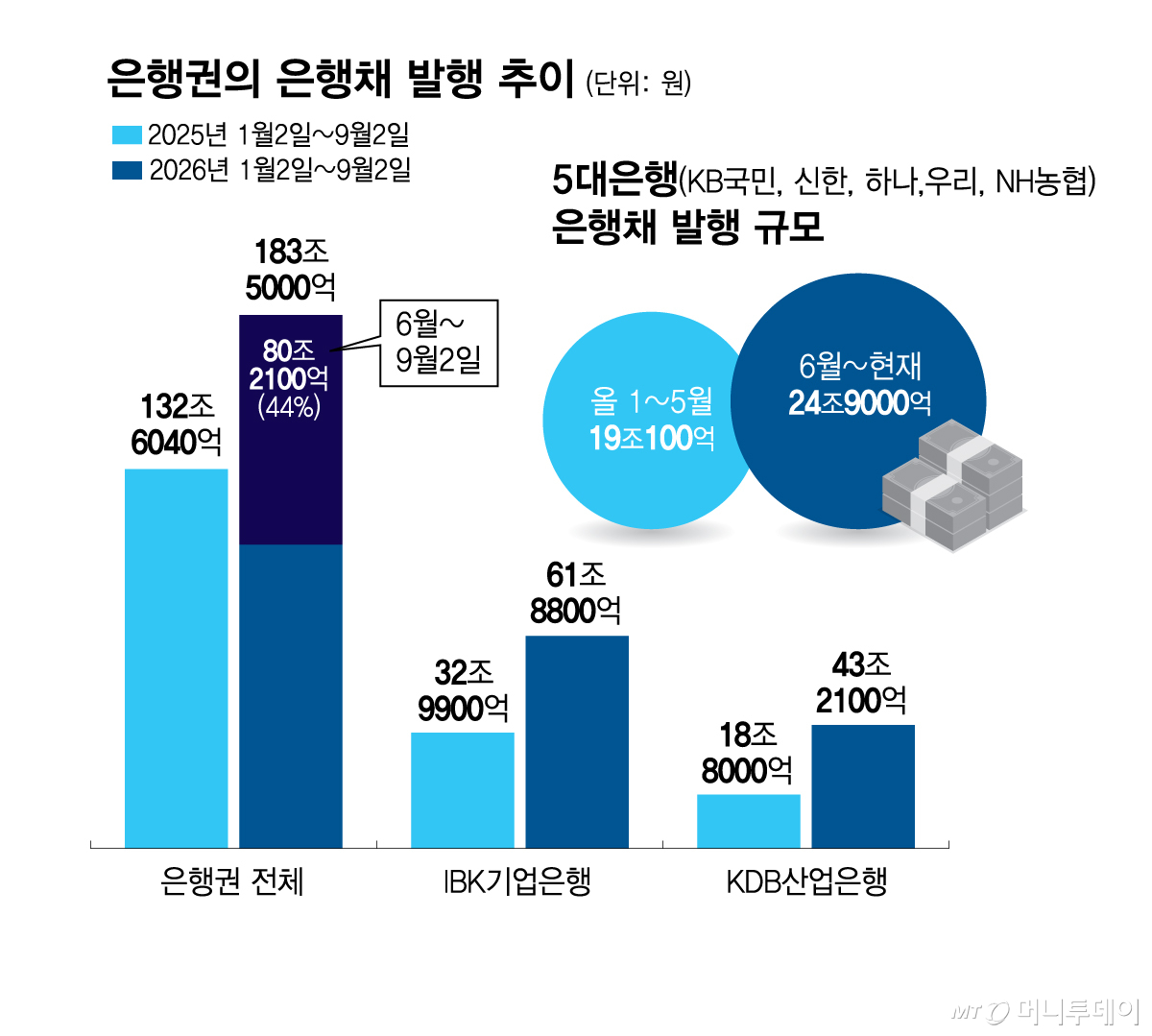
According to the Korea Financial Investment Association on the 3rd, cumulative bank bond issuance by banks from the beginning of this year through the 2nd reached 183.5 trillion won, up 38.3% from 132.604 trillion won during the same period last year.
"Bank bonds are bonds issued by banks with fixed maturities and interest rates, serving as a major funding tool alongside deposits. They offer the advantage of stably securing large-scale funds at once over a relatively long period.
By bank, the surge in issuance is particularly notable among special banks such as Industrial Bank of Korea and Korea Development Bank. Industrial Bank of Korea issued 61.88 trillion won in bank bonds through the 2nd, more than doubling from 32.99 trillion won during the same period last year. Korea Development Bank also issued 43.21 trillion won during the same period, more than doubling from 18.8 trillion won last year.
The banking sector interprets this as special banks expanding fundraising to supply policy financing amid the expansion of productive financing. While loan assets such as credit have increased significantly, their customer base remains relatively weak, leading to a slower pace of growth in deposit-based funding assets.
In fact, Industrial Bank of Korea's savings deposits grew only 0.5%, from 75.3991 trillion won at the end of last year to 75.8118 trillion won by the end of June this year. During the same period, SME (small and medium-sized enterprise) lending increased 3.1%, from 261.8785 trillion won to 270.5 trillion won.
Korea Development Bank shows a similar trend. Total deposits rose 4.3% from 68.4749 trillion won at the end of last year to 71.4147 trillion won by the end of June this year, but corporate loans increased 5.0%, from 197.2449 trillion won to 207.546 trillion won, exceeding the growth in deposits.
In particular, the increase in bank bond issuance this year is concentrated in the second half. Of the total 183.5 trillion won in bank bond issuance by banks, 80.21 trillion won was issued after June, accounting for 43.7% of the total. The concentration is even higher when looking at net issuance. This year's net bank bond issuance stood at 32.3382 trillion won, with 25.9982 trillion won issued after June, representing 80.4% of the total.
This is because commercial banks have also increased their bank bond issuance since the second half. With many bank bonds maturing in the first half and deposits shifting to the stock market amid a booming equity market, banks are seeking to compensate for the shortfall in deposits. The five major banks (KB, Shinhan, Hana, Woori, NH) issued 19.1 trillion won in bank bonds from the beginning of this year through May, but issued an additional 24.9 trillion won over the following three months starting in June.
In particular, while bank bond issuance has also increased recently due to expanding demand for household loans, investor demand for purchasing these bonds remains relatively low, deepening banks' concerns. Bonds have a structure where prices fall when market interest rates rise, making it difficult for investors to rush into bond purchases during periods of rising rates. Especially as the upward trend in market interest rates continues, more investors are waiting to observe interest rate movements. While raising issuance rates can attract investors, it also increases banks' cost of fundraising.
A banking sector official stated, "Net bank bond issuance decreased through May, leading to an increase in issuance after June," adding, "Banks want to issue more, but demand is not sufficient due to issues such as the U.S.-Iran war."

 in FINANCE
