

In the homeland of venture investment, Silicon Valley, it is rare to find a practice where startup failure liability is placed on individual founders to recover invested funds. The so-called "joint guarantee," often cited as a typical abusive clause in venture investment contracts, has never taken root. This is due to a shared culture among investors, fund managers, and entrepreneurs that acknowledges most startups will inevitably fail.
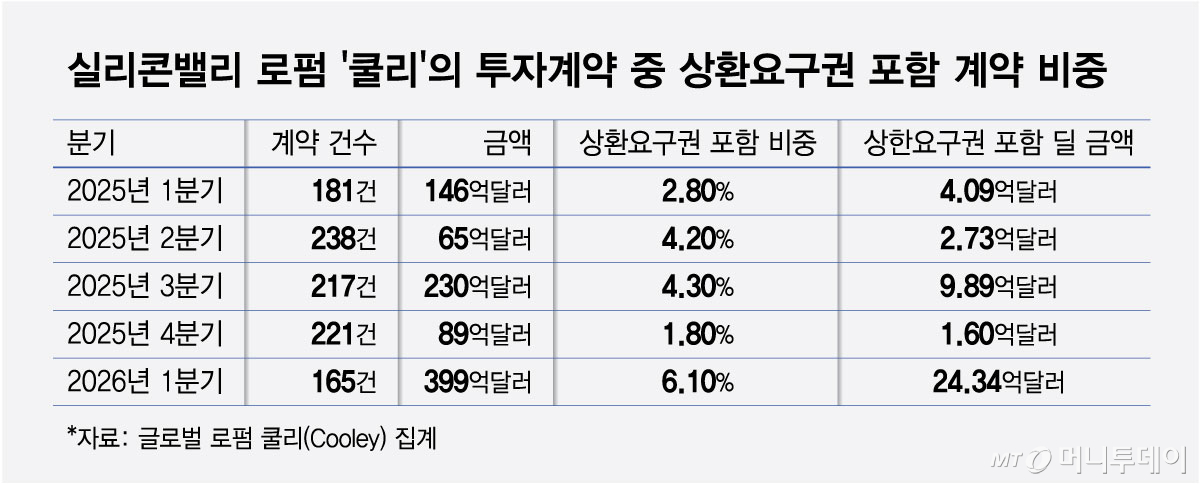
According to Cooley's quarterly venture investment report, one of the law firms handling the most startup contracts in Silicon Valley, contracts containing "redemption rights" clauses accounted for only 2–6% per quarter. This contrasts sharply with the fact that most domestic venture investment contracts are structured as redeemable convertible preferred shares (RCPS). A representative from a major Korean venture capital firm stated, "While there has been a slight increase in contracts written as CPS recently, RCPS contracts still account for 85–90%."
According to Cooley, Silicon Valley investment practices lean more toward protecting entrepreneurs compared to Korea, which prioritizes investor protection. As of the fourth quarter last year, 98% of Cooley's contracts included conditions allowing investors to recover only 100% of their invested funds first. Additionally, 96% of all contracts were "non-participating preferred shares," where investors could choose either principal recovery or equity distribution, but not both.
The gap is even wider in the case of liquidation preferences. According to Cooley's data for the third quarter of 2024, a weighted average method was applied to all investment contracts during that period. Not a single contract used the lowest-price method (put option), which is widely used in Korea. The weighted average method, recently recommended by the Ministry of SMEs and Startups through standard contract revisions, has already become the standard in the United States.
This entrepreneur-centric contract practice is widely believed to have emerged from Silicon Valley's venture investment culture that treats failure as Yongin. Kim Sung-hoon, a lawyer at Mission Law Firm, shared, "When I asked a Silicon Valley VC representative why there are no joint liability clauses or put options in the U.S., they replied, 'It's strange you're asking why something that never existed doesn't exist.' They also pointed out that 99% of venture startups fail while taking on risky endeavors. If entrepreneurs were held jointly liable every time, who would dare to start a business?"
Market structures that prevent investors from unilaterally setting conditions also play a role. The more promising the startup, the more choice founders have in selecting investors. Investment firms proposing unfavorable terms to entrepreneurs cannot secure good deals.
A VC investment screening officer noted, "The fact that Silicon Valley has fewer investor safety mechanisms than Korea is certainly not because investors are more generous. It is closer to the result of the entire ecosystem learning that shifting recovery burdens onto individuals does not work in a market where failure is the baseline."
[MoneyToday Startup Media Platform Unicorn Factory]

 in FUTURE
