

[For more diverse corporate information on startups, visit Unicorn Factory's Big Data Platform Data Lab.]

When Korean companies create products and look abroad for the first time, their target markets are usually either the United States or Japan. The Middle East, one of the fastest-growing economic blocs in the world, is not an option. It is too far, unfamiliar, and there have been almost no people actually doing business there.
One person stepped directly into this void: Yoon Chang-min (CEO), who leads Shoruk Partners (Shoruk), the largest VC in the Middle East, as its Korea head and also runs its affiliate company, Sprint. He has taken on the role of an investor while simultaneously becoming a 'merchant' selling K-brands to the Middle East.
Shoruk Partners is a Middle East-based VC co-founded in 2017 by Korean Shin Yu-geun (CEO) and CEO Mahmoud Adi. With hubs centered in Abu Dhabi, UAE, and extending to Riyadh, Doha, Cairo, and Seoul, its AUM (assets under management) has grown to over 1 trillion won.
The fund lineup is also robust. It includes three venture funds, an AI fund created with the listed company PrLisa under G42, a subsidiary of the Abu Dhabi government; a growth fund established with Qatar Investment Authority (QIA); and credit, real estate, and special situation funds.
The LP (limited partner) structure is also unique. It is centered on Middle Eastern sovereign wealth funds such as Saudi Arabia's PIF and QIA, along with local family offices, while Hanwha and Kakao have also joined the list. Yoon (CEO) is responsible for deal sourcing and value creation in Korea.
Having worked through a Hong Kong private equity fund and a Singapore hedge fund before starting his own business, Yoon (CEO) found that investment work was never easy for him. While entrepreneurship allows one to simply execute their own ideas, investing involves imposing subjective judgments on others' businesses.
It is said that he eventually told Shoruk he wanted to leave. However, the response was not a rejection but a new proposal: to build a business entity connecting Korea and the Middle East directly within Shoruk. This became the starting point for Sprint, established simultaneously in Abu Dhabi and Korea last January.
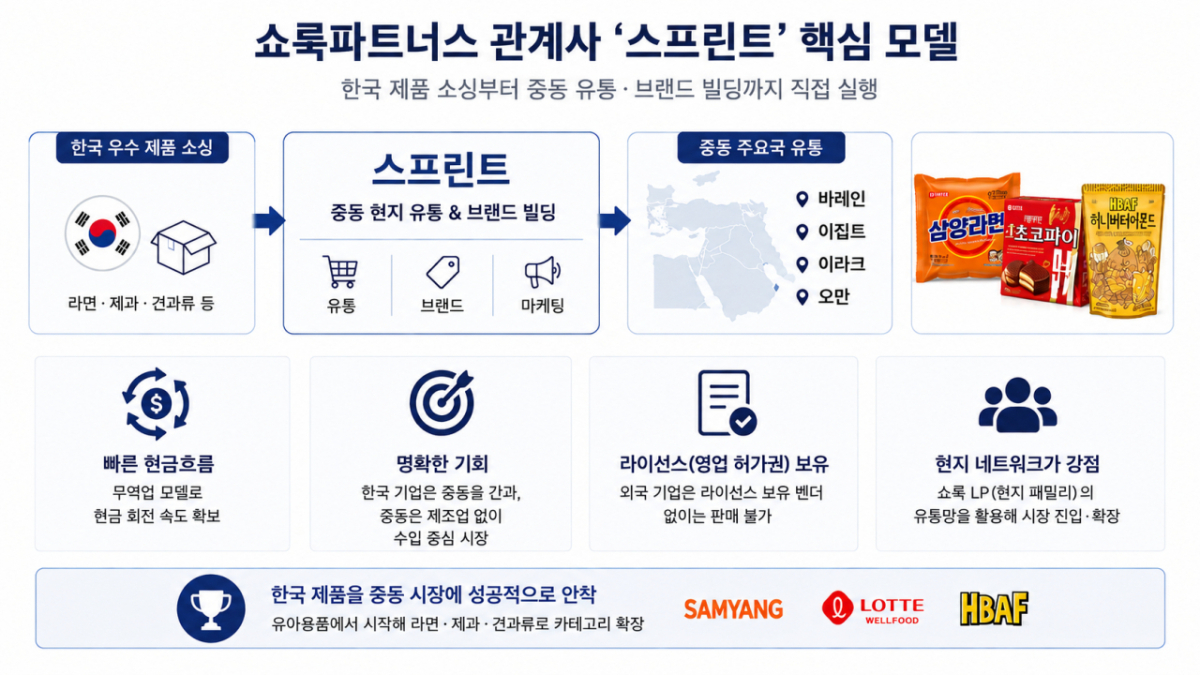
Sprint is an execution organization that sources high-quality Korean products, distributes them directly in the Middle East, and specializes in brand building. It is highly unusual for a VC firm to operate a distribution company directly.
Yoon (CEO) chose trade as his business model for two reasons: cash flow turns quickly, and opportunities are clear. Korean companies have not deeply considered the Middle East, while the Middle East has been a market that imported European and American products without manufacturing for hundreds of years.
For foreign companies to sell products in the Middle East, they need licenses (business permits). Even large corporations must partner with vendors holding such licenses. The fact that local family offices, which are LPs of Shoruk, control distribution networks became Sprint's powerful weapon.
It started with baby products. Later, it secured sales rights for Samyang, Lotte Wellfood, and BHF (HBAF), distributing instant noodles, confectionery, and nuts to major Middle Eastern countries including Bahrain, Egypt, Iraq, and Oman.
Yoon (CEO) stated, "Even large corporations did not necessarily take good care of the Middle East market." He added, "After researching data, I found that sales in the Middle East by large corporations had remained almost unchanged for decades. I became convinced we could do this much better."
Sprint began sourcing K-beauty brands at the request of local Middle Eastern buyers. It has already secured 65 brands. However, after operating for a year, only about 10 were actually selling well. The remaining 55 brands could not be sold to buyers no matter how much they were introduced.
Yoon (CEO) said, "The reason was clear. Only brands already verified overseas, such as MediCube and Anua, were selling." He noted, "I confirmed within a year that the theme of 'K-beauty' alone is not enough; even well-performing brands in Korea do not necessarily succeed locally."
He also felt the limitations of the distribution business itself. Margins are thin, and dependence on buyers is high, so if clients switch partners, there is no way to intervene. Thus, they kept only large corporation products with substantial distribution volumes and shifted other indie brands to a different model. The idea was: "Let money spent in the US be spent in the Middle East."
He explained, "Usually, brands need to blow up on TikTok or Instagram in the US first before their influence reaches the Middle East, but few brands can afford the costs until then." He added, "We are gathering brands by appealing that starting directly in the Middle East involves less competition and is much cheaper."
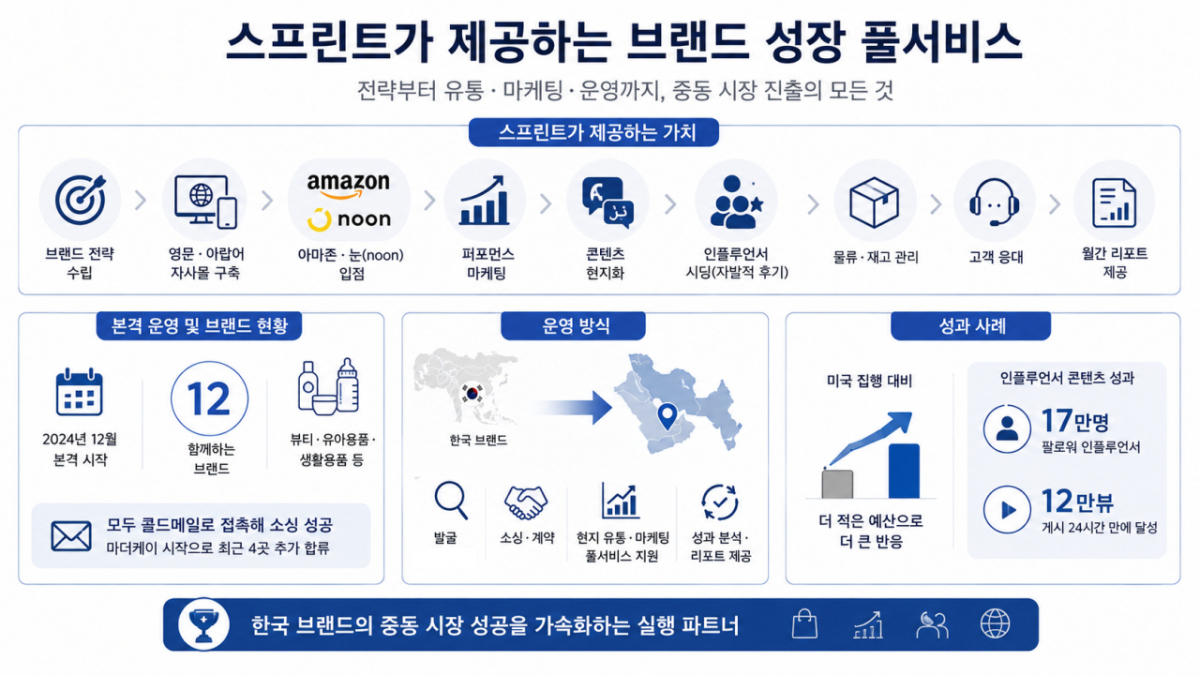
The value Sprint provides to brands ranges from brand strategy formulation, building English and Arabic official stores, entering Amazon and Noon (local e-commerce platforms), performance marketing, content localization, influencer seeding (voluntary reviews), logistics and inventory management, and customer service. They also send monthly reports.
This approach officially began last December, and currently 12 brands are working together. All were successfully sourced through cold emails. Starting with 'Mother K', beauty, baby product, and household brand companies joined in succession, with four more added recently.
Results are becoming visible. One brand operated for six months achieved a much larger response in the Middle East with significantly less budget than if it had been executed in the US. Content created with an influencer having 170,000 followers recorded 120,000 views within 24 hours of posting.
Yoon (CEO) said, "Middle Eastern influencers have rarely encountered Korean products but are highly interested in Korea, so seeding is mostly done for free." He added, "They want to introduce well-performing Korean products themselves first."

Sprint also directly operates the local pajama brand 'Silk n Love'. Created to learn the e-commerce grammar of the Middle East firsthand, this brand has recently gained popularity through word-of-mouth on Amazon in the Middle East, becoming a self-referential model for brand operations.
Yoon (CEO) clearly identifies characteristics of Middle Eastern consumers. Due to hot weather, there is no street commerce; they prefer online platforms or large shopping malls. He explains that this creates an advantageous structure for Korean indie brands that excel in online marketing compared to global major brands.
Cultural changes in Saudi Arabia also present a huge opportunity. He stated, "Five years ago in Riyadh, most women went out with only their eyes visible, but now they reveal their entire faces." He added, "The 'desire to beautify' that was suppressed for so long is now being expressed through consumption of beauty brands."
Yoon (CEO) described the Middle East as a "developing country with money." Unlike consumers in advanced countries who scrutinize ingredients and efficacy, people there buy simply because something is 'hot.' This means it is a market where building brand awareness works much faster.
Through meeting numerous brands directly, he also considers investments at the Shoruk level when discovering companies with excellent business potential and high growth prospects. According to Shoruk's fund of funds (Korea venture fund) investment commitments, there is at least 4 billion won that must be deployed in Korea this year alone.
Yoon (CEO) shows strong interest in teams where Sprint's distribution model can create synergy. For example, 'Absorbio', a derma beauty brand launched last March with projected annual sales of 4 billion won, is currently discussing investment and Middle East distribution alongside its current operations.
He remarked, "I now understand well why the form of the largest companies in Korea and Japan was once the 'sangsa' (a company organized for trade and commercial activities)." He added, "No place has as much information on what sells well where and at what price as a sangsa."
He further emphasized, "While the Middle East possesses consumption power comparable to the US and Europe, few companies implement proper strategies there. We will grow Sprint as a 'gateway' for distribution and brand building for companies wishing to enter the Middle East."
[MoneyToday startup media platform 'Unicorn Factory']

 in FUTURE


