

◇Stocks Hit in AI Supply Chain
As the "AI speed bump theory" gains traction in the United States, attention is also focused on its potential impact on semiconductor-related stocks including Samsung Electronics, SK Hynix, and U.S.-based Micron. Market experts believe that semiconductor and AI supply chain-related stocks could face short-term setbacks. However, given that the long-term growth trajectory remains intact, they anticipate a low likelihood of the fallout extending over the long term.
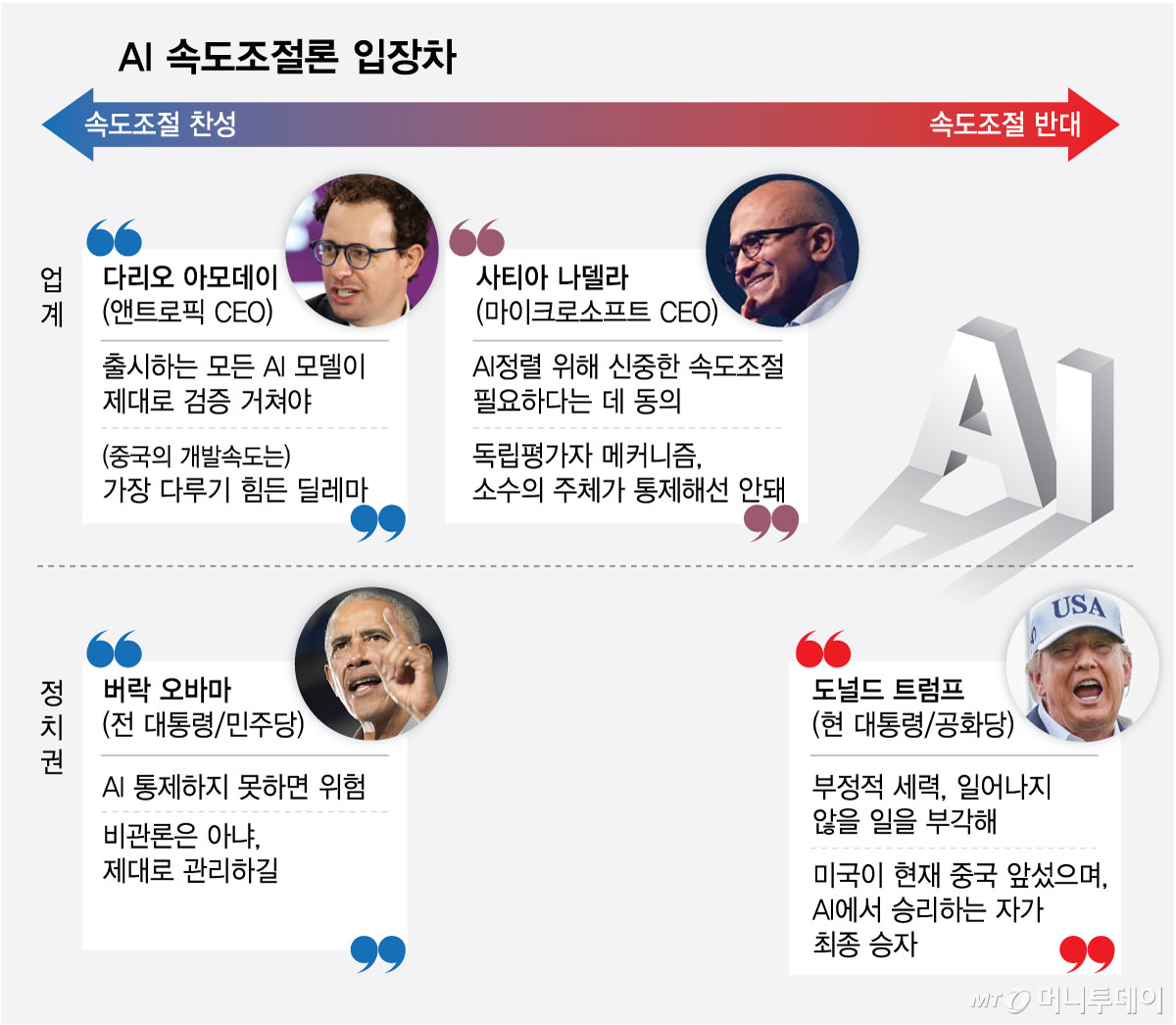
According to Bloomberg on the 13th (local time), market strategists pointed out that a cautious approach to AI development could trigger short-term selling pressure on semiconductor manufacturers and AI supply chain-related stocks. This is because concerns are growing that a cautious stance toward developing advanced AI models could weigh on the earnings of related companies. Earlier, Dario Amodei, CEO of Anthropic, proposed slowing down AI development to ensure safety measures keep pace with advances in AI capabilities, a move publicly supported by OpenAI's Sam Altman and Elon Musk.
However, the prevailing view is that this recent setback will not derail the long-term growth trend of AI investments. Gary Tan, portfolio manager at AllSpring Global Investments, stated, "While these remarks may lead to short-term stock price pressure, it is unlikely they will shake the long-term flow of AI investment." He added, "Since AI development is still in its early stages and technology is evolving rapidly, it remains questionable whether other players in the ecosystem would be satisfied with their current rankings and choose to slow down."
There are also observations that the speed-bump theory could serve as an opportunity for companies to reduce infrastructure cost burdens and improve profitability. Billy Leung, investment strategist at GlobalX Management, noted, "It may actually have the effect of extending development timelines." He analyzed, "As AI commercialization and adoption continue to expand, if the pace of new technology development slows slightly, it could help transition from the infrastructure construction phase to a stage where revenue is generated using already-established technologies."
Charu Channan, senior investment strategist at Saxo Markets, explained, "Demands for enhanced safety measures will likely lead to new spending and expanded revenues in areas such as cybersecurity and AI monitoring. Even if development speeds moderate somewhat, demand for computing power will persist, which in turn further solidifies the long-term profit-generation structure of the AI industry."
Amid this, OpenAI CEO Sam Altman stated in a Fortune interview that "given the situations unfolding regarding AI safety, now is not an appropriate time for an IPO," announcing that the company would not pursue an initial public offering (IPO) this year. Anthropic CEO Dario Amodei also appeared on a U.S. broadcast, saying, "This does not mean we need to be terrified today or halt all development," but clarified, "It means every generation of models we release must undergo proper validation."
◇Trump vs. Obama Jeon Hyeon (President) Divergent Stances= Major AI companies are reportedly discussing the establishment of a standards body to create joint testing and auditing systems. IT specialist media DeInform reported that since July, a working group composed of executives under the CEOs of Anthropic, OpenAI, and Google has been meeting regularly.
In this regard, Microsoft (MS) CEO Satya Nadella agreed with Amodei's call for AI speed control and the introduction of external oversight but emphasized that a small number of entities should not be responsible for AI monitoring and control. He stated, "It must have broad representation across the ecosystem, academia, nations, and sectors." Speaking on social media platform X (formerly Twitter), Nadella said, "Any journey toward superintelligence must be rooted in the core principle that 'there is no value in pursuing an AI that does not benefit humanity or remains outside human control.'" He further proposed "human control" and "benefit sharing" as the Daejeon principles for superintelligence development.
Meanwhile, Barack Obama Jeon (President) said at a closed-door fundraising event for the U.S. Democratic Party on the 10th that "AI could become dangerous if not properly controlled," urging the Democratic Party to make AI response a key political agenda. In contrast, U.S. President Donald Trump drew a line against the speed-bump theory during his visit to Ireland on the 13th, stating, "There are too many negative forces highlighting things that should not be highlighted; they are focusing on events that will never happen." President Trump emphasized, "The United States is currently ahead of China in the AI field," and added, "The one who wins in AI becomes the ultimate winner."
◇Strong Demand to Continue for Now
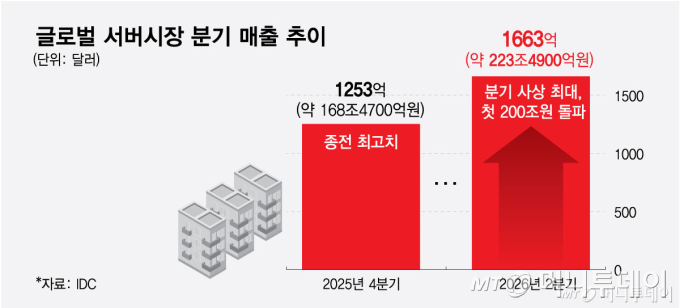
Driven by expanded investment in AI (artificial intelligence) infrastructure, global server market sales have exceeded 200 trillion won on a quarterly basis for the first time. With increased adoption of high-performance components for AI computation, the average selling price (ASP) of servers also rose significantly. As demand has spread beyond HBM (high-bandwidth memory) to include DDR5 (double data rate 5) and eSSD (enterprise solid-state drive), all types of memory semiconductors, favorable market conditions are expected to continue for domestic memory companies such as Samsung Electronics and SK Hynix.
According to market research firm IDC on the 14th, global server market sales in the second quarter of this year reached $166.3 billion (approximately 223.49 trillion won), marking a record high on a quarterly basis. This is the first time quarterly sales have surpassed 200 trillion won. The figure represents a 32.7% increase compared to the previous record of $125.3 billion (approximately 168.47 trillion won) in the fourth quarter of last year.
Investments in AI infrastructure by hyperscalers (large-scale data center operators) and CSPs (major cloud service providers) drove market growth. In particular, while global server shipments increased by 15.4% year-on-year in the second quarter this year, sales revenue surged by 52%. This indicates that not only were more servers sold, but the ASP per server also rose significantly.
GPU (graphics processing unit) acceleration servers are a prime example. The ASP of GPU-accelerated servers rose 43.6% year-on-year to $170,200 (approximately 229 million won). Sales of other servers equipped with ASICs (application-specific integrated circuits) and similar components also surged by 237.6% during the same period. Analysts suggest that as AI infrastructure investment diversifies from being centered on NVIDIA GPUs to include proprietary AI accelerators developed by big tech companies, server specifications are becoming more advanced at a faster pace.
As the "value" of servers rises, Samsung Electronics and SK Hynix are expected to continue their growth momentum. This is because AI servers require not only HBM but also high-value, high-capacity memory such as DDR5 for servers that support data processing and eSSD for storing large-scale data. The same logic applies when NVIDIA CFO Colette Kress recently stated during the 2027 fiscal year second-quarter earnings announcement conference call that "today's memory shortage is largely caused by AI construction itself."
In fact, rising memory prices are a key factor driving up server ASPs. IDC stated, "Server suppliers cite rising DRAM and NAND flash prices and increased component allocation as the main reasons for price hikes." This is also why global big tech companies are entering into long-term supply agreements (LTA) with memory manufacturers. Samsung Electronics has already signed an LTA with a global big tech company and has now entered negotiations with five additional major customers. Typically, these contracts follow a "rolling" method where the contract period is extended by one year annually over a standard five-year term. SK Hynix has also signed LTAs with about 10 customers, including key clients.
With expanded AI infrastructure investment and strong memory prices, earnings estimates for both companies are rising. According to financial information provider FNGuide, the combined operating profit consensus estimate (average analyst forecast) for Samsung Electronics and SK Hynix this year stands at 656.054 trillion won, exceeding seven times their combined operating profit of 90.8074 trillion won last year.
An industry official said, "AI servers have higher memory capacity and product specifications than existing servers, so the growth of the server market directly leads to expanded demand for high-value memory." He added, "As long as AI investment continues, demand for server memory such as HBM, DDR5, and eSSD will remain robust."
◇AI Infrastructure Business Booming
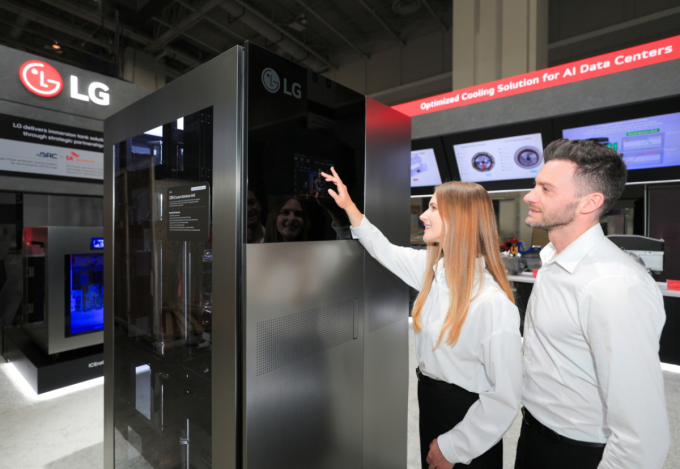
LG Electronics is accelerating its efforts to capture the rapidly growing global AI data center cooling solutions market. The company is undergoing additional certification procedures for liquid cooling core equipment from NVIDIA. Based on this, LG aims to enhance its competitive edge in cooling solutions to address increased heat generation from high-performance AI servers and secure additional orders worth trillions of won.
According to the electronics industry on the 14th, LG Electronics is currently undergoing final quality certification from NVIDIA for its 1MW (megawatt) class "Coolant Distribution Unit (CDU)." It is reported that LG has conducted its own tests in line with performance standards required by NVIDIA and submitted relevant data.
LG Electronics received final quality certification from NVIDIA last July for its 600kW class CDU. Following the 1MW certification, LG plans to expand CDU certification capacity to 2.5MW and 4MW classes. The company has essentially completed development of a 1.4MW CDU and aims to launch and begin certification procedures for 2.5MW and 4MW products within this year.
CDUs are core equipment for liquid cooling in AI data centers. As the performance of high-performance GPUs (graphics processing units) and HBM (high-bandwidth memory) has recently improved, the power consumption and heat generated by a single AI server rack have increased rapidly. Existing air-cooling methods alone have limitations in handling the heat from high-performance AI servers.
Consequently, the importance of "Direct-to-Chip (DTC)" liquid cooling, which attaches cold plates to high-heat chips like GPUs and CPUs to directly absorb heat with coolant, is growing. In DTC systems, CDUs send coolant to servers, absorb heat from chips, collect the heated coolant, cool it down again, and circulate it back.
The larger the capacity of a CDU, the more heat it can handle. In particular, industry observers view 2.5MW-class CDUs as a key turning point in the next-generation AI data center cooling market. NVIDIA's next-generation "Vera Rubin NVL72" uses up to 330kW of power per server rack, which is about 2.7 times higher than previous generation models.
LG Electronics is expanding its thermal management business from its existing operations that cool data center spaces using large chillers and HVAC equipment to include liquid cooling areas around server racks and chips. The strategy involves building a portfolio covering the entire data center cooling system, from chillers to CDUs and cold plates.
According to NVIDIA's AI Factory Infrastructure public information, only about 20 companies worldwide have received CDU certification. Passing this verification means meeting technical requirements such as cooling performance and stability demanded by NVIDIA AI servers. This lays the foundation for expanding orders to hyperscalers (large-scale data center operators) in the future.
Market growth is also steep. The global AI data center market is projected to grow at an annual rate of about 26%, reaching approximately $133.5 billion (about 185 trillion won) by 2034. LG Electronics is also expanding its orders for data center cooling systems targeting global hyperscalers. Orders related to AI data center cooling in the first half of this year exceeded 600 billion won, and the company aims to secure additional orders worth trillions of won by year-end.
An industry official stated, "Since most global AI data centers currently use NVIDIA products, NVIDIA's certification carries significant meaning and its requirements are stringent." He added, "Most server rack and data center design companies prefer to use certified products."

 in INDUSTRY


