

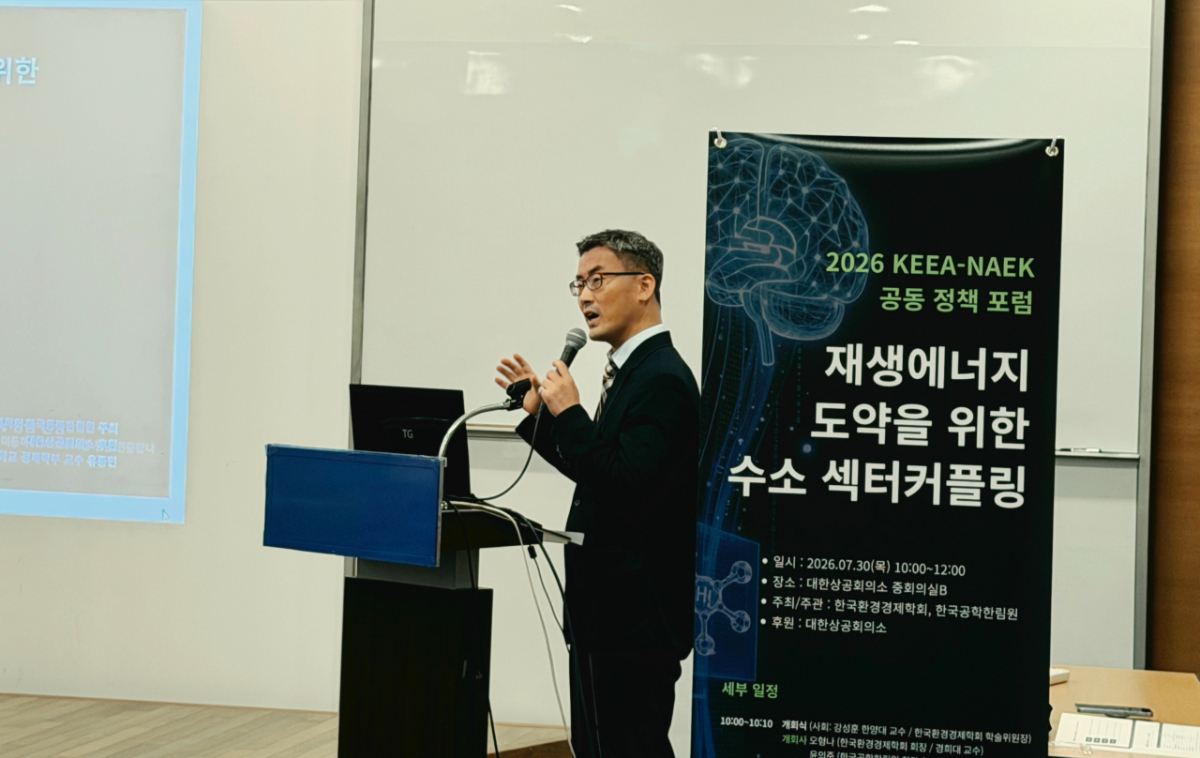
A diagnosis has emerged that hydrogen is not merely one of several options in the 100GW renewable energy era but a 'strategic asset' essential for supporting grid stability and energy security. This is because it can complement the intermittency of solar and wind power while storing and transporting excess electricity over long periods, thereby reducing the burden on transmission networks. Analyses also suggest that hydrogen's economic viability must be evaluated by considering its broader effects across the entire power system, such as lowering investment costs for transmission infrastructure and enabling long-term storage of surplus power.
Yoo Jong-min, Hongik University Gyeong Je-hak-bu (Prof.), made these remarks at the 'Hydrogen Sector Coupling Policy Forum for Renewable Energy Leap,' jointly hosted by the Korean Society of Environmental Economics and the Academy of Engineering Korea, on the 30th at the Korea Chamber of Commerce and Industry in Jung-gu, Seoul. He emphasized that "in the 100GW renewable energy era, hydrogen is no longer an optional supplement but a strategic asset that must be secured," adding that "hydrogen's role is critical from four perspectives: energy security, grid stability, system-wide economic efficiency, and policy integration."
In reality, as the share of renewable energy rises, so do fluctuations in power generation and the operational burden on transmission grids. Even if excess electricity is generated by solar power during the day, output must be curtailed if there are insufficient transmission lines to deliver it to semiconductor factories or artificial intelligence (AI) data centers in the Seoul metropolitan area. Battery-based energy storage systems (ESS) also face limitations in storing large-scale seasonal surplus electricity over several months.
Professor Yoo identified hydrogen as a key solution to these bottlenecks. By using excess electricity to electrolyze water and produce hydrogen, it can be compressed, liquefied, or converted into ammonia for long-term storage and transported to where needed at any time—unlike electricity, which must match supply and demand in real time. While batteries handle short-term supply and demand, hydrogen is tasked with long-term, large-scale storage across seasons and energy transfer between regions.
Professor Yoo also maintained that hydrogen's economic viability should not be judged solely by production costs or power generation rates. Although it may appear expensive when viewed as an isolated power source, the overall system cost reduction becomes significant when factors such as long-term storage, reserve capacity, reduced output curtailment, and savings on transmission infrastructure investments are included.
From an energy security perspective, hydrogen can reduce reliance on fossil fuel imports. Since hydrogen can be produced domestically from renewable energy, and imported clean hydrogen allows diversification of sourcing countries and transportation methods, it can serve as an 'energy safety net' to respond to supply chain shocks.
He particularly urged accelerating the transition of commercial vehicles such as buses and heavy trucks—which account for half of transport sector emissions—to hydrogen fuel cell vehicles. Given that a shift focused solely on electric passenger cars would struggle to cope with charging infrastructure demands and grid burdens, he proposed a Korean-style transition strategy that incorporates hydrogen vehicles alongside electric ones, considering the operational characteristics of commercial vehicles that cover long distances.
Professor Yoo noted, "Elon Musk, Tesla's chief executive, dismissed hydrogen vehicles based on assumptions of America's abundant power grid—a premise that does not apply to Korea, where grid constraints are significant." He added, "Commercial vehicles have long operating distances and fixed routes, making demand forecasting and hub-based charging station management easier." He proposed establishing a medium-to-long-term roadmap linking vehicle rollout with charging infrastructure, aiming for mandatory hydrogen vehicle adoption of over 50% for buses and heavy trucks alone.
During the subsequent panel discussion, consensus emerged that hydrogen should expand its role as an energy transition tool connecting power, transport, and industrial sectors. Professor Moon Il of Yonsei University stated, "Considering the urgency of launching mega-projects with projected large-scale electricity demand, hydrogen fuel cell power generation offers a practical alternative due to its relatively short construction period and ability to utilize diverse energy sources." Kang Byung-wook, head of the Hydrogen Economy Research Team at the Korea Energy Economics Institute, analyzed that while hydrogen vehicles have been treated as less efficient alternatives compared to electric cars, their policy viability could increase when considering benefits such as reduced grid investment costs and distributed charging demand.

 in INDUSTRY
