

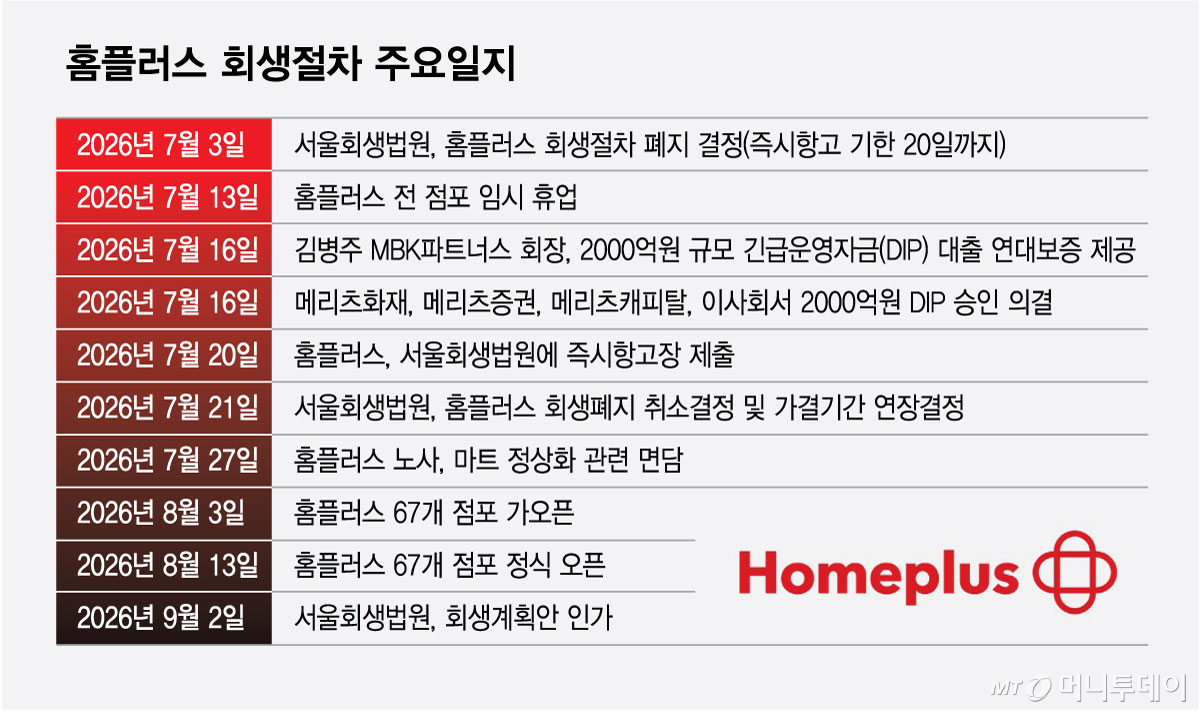
As Homeplus secured court approval for its reorganization plan and breathed a sigh of relief, there are growing expectations that the Financial Supervisory Service's disciplinary review against securities firms that sold short-term bonds (ABSTB) may be delayed until the fourth quarter. The Financial Supervisory Service is reviewing 'priority compensation followed by final settlement' for investors in these bonds and has adopted a stance to expedite both disciplinary actions and dispute resolution procedures.
According to financial authorities and industry sources on the 3rd, the schedule for the Financial Supervisory Service's Disciplinary Committee review of Hana Securities, which sold the largest volume of Homeplus short-term bonds to individual investors, remains undetermined. The Financial Supervisory Service conducted an inspection into allegations of incomplete sales by Hana Securities and issued an inspection opinion letter. This letter outlines general violations and irregularities; the formal disciplinary committee procedure will only begin after a detailed advance notice is issued, specifying concrete violations, legal grounds for sanctions, and their levels.
According to authorities and industry sources, no advance notice has yet been sent to Hana Securities. Typically, the Financial Supervisory Service sends such notices 7–10 days before convening the Disciplinary Committee, allowing the financial institution time to file objections and prepare its defense.
The Financial Supervisory Service's September Disciplinary Committee sessions were held on the 3rd and 17th, totaling two meetings. Considering that no advance notice has been issued as of today, some observers predict that the formal disciplinary process may be pushed into the fourth quarter.
No disciplinary hearing schedule has yet been finalized for Shinhan Securities, which issued short-term bonds and sold them to other securities firms (sell-down). Given that Financial Supervisory Service Chairman Lee Chan-jin directly mentioned Hana Securities, it is highly likely that disciplinary proceedings against sellers will precede those against issuers. On July 21, during a National Assembly Political Affairs Committee session, Chairman Lee stated regarding the Homeplus short-term bond investment issue: "Inspections have been conducted on Hana Securities and related investigations are substantially complete," adding, "We are actively considering relief measures."
Interest in the disciplinary review schedule for Homeplus short-term bonds is closely tied to investor compensation. In materials submitted to the office of Democratic Party of Korea lawmaker Kim Hyun-jeong, the Financial Supervisory Service stated: "If incomplete sales are confirmed through inspection and disciplinary results, we are reviewing a system where priority compensation is provided first, followed by final settlement after damages are determined." Since 'priority compensation followed by final settlement' may be implemented if incomplete sales are confirmed in disciplinary outcomes, investor relief efforts are directly linked to the results of the disciplinary review.
The level of sanctions against Hana Securities, the largest seller, and Shinhan Securities, the issuer, is also a key concern for the industry. The Financial Supervisory Service is expected to conduct separate disciplinary proceedings for both firms. Hana Securities sold the highest volume of Homeplus short-term bonds to individual investors. Depending on whether incomplete sales occurred at individual branch levels due to issues such as insufficient recording during sales, or whether broader financial consumer protection problems existed at headquarters level due to deficiencies in product explanation documents, the severity of sanctions is expected to vary significantly.
Unlike one-off financial investment products, short-term bonds with short maturities allow for redemption, which also increases commission revenues for selling firms each time redemption occurs. If redemptions continued amid inadequate implementation of financial consumer protection principles such as disclosure obligations and suitability standards, it would likely reignite the long-standing industry criticism of 'short-term performance focus' within the securities sector.
The product at the center of the incomplete sales issue involving individual investors is a short-term bond issued based on receivables from Homeplus that must be paid to credit card companies for purchases made with dedicated payment cards. Victims of Homeplus merchandise purchase short-term bonds argued during a stakeholder meeting the previous day that "to receive repayment of a significant portion of the bond value, they would have to wait until 2037," and thus opposed the reorganization plan.
Regarding the disciplinary review procedure for short-term bonds, a Financial Supervisory Service official stated: "Our policy is to expedite dispute resolution related to Homeplus short-term bond sales, and inspections and disciplinary actions will be conducted as swiftly as possible."

 in STOCK
