

An analysis has emerged indicating that the structure of Multiple Program Providers (MPPs) repeatedly scheduling identical content across multiple channels within their group and then trading them as a bundled package increases the content cost burden on paid broadcasting companies.
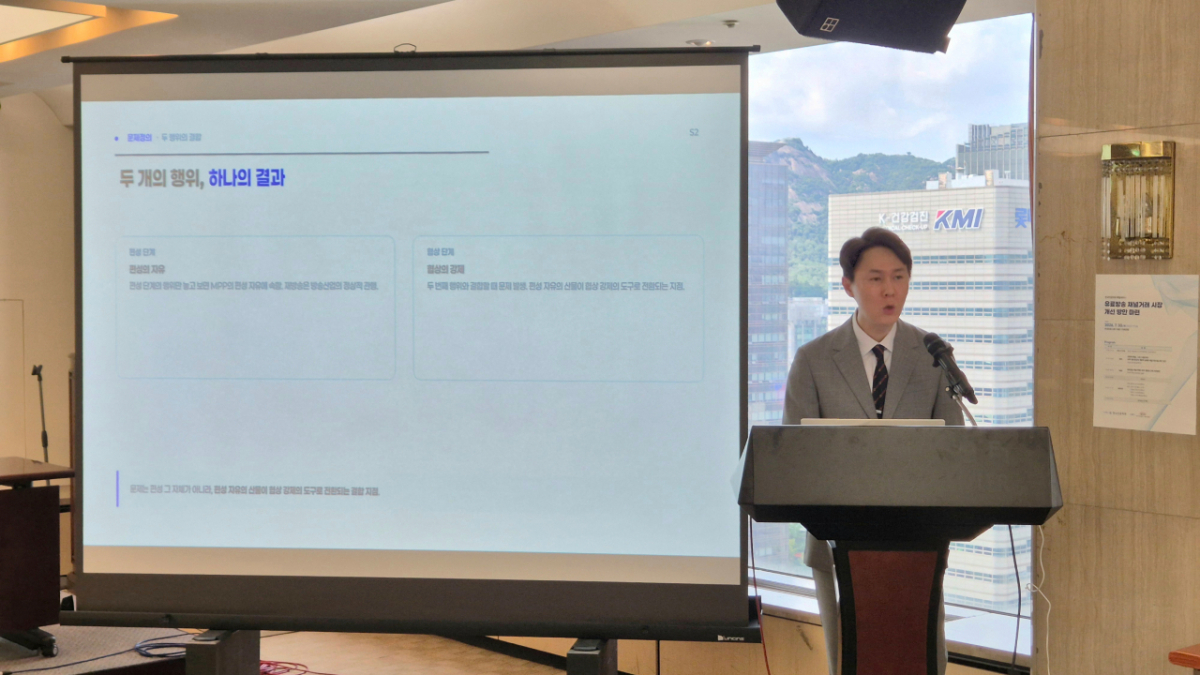
On the 30th, Professor Yoo Sung-jin of Soongsil University Gyeong Yeong-hak-bu (Prof.) presented findings from an analysis of 193 channel combinations across nine MPPs and 43 channels at the Korean Communication Society seminar titled "Establishing Measures to Improve the Paid Broadcasting Channel Trading Market," held at the Korea Press Center in Jung-gu, Seoul. MPP refers to PP (Program Provider), which operates multiple channels including CJ ENM and terrestrial broadcasters.
According to the presentation, channels operated by the same legal entity showed up to 98% content overlap. Professor Yoo explained that "the problem with repeated scheduling is that multiple channels are presented as a single bundle at the negotiation table." Paid broadcasting companies pay program usage fees to MPPs and transmit their channels. Revenue comes from viewer subscription fees paid by audiences.
The issue lies in the fact that negotiations over program usage fees between paid broadcasting companies and MPPs often hinge on just one or two flagship channels, forcing broadcasters to pay separate fees for channels that only air duplicate content. This is a form of "bundling."
Paid broadcasting companies allocate most of their revenue to program usage fees. According to the Korea Cable TV Broadcasters Association, in 2024, paid broadcasting companies paid 90.2% of total reception fees as program usage fees. Professor Yoo explained that "duplicate channels consume limited resources for content usage fees."
Professor Yoo argued that three-stage improvements are necessary to ensure the effectiveness of anti-bundling enforcement measures. The first stage involves revising existing guidelines to recognize channel termination as a separate ground if an MPP is confirmed to have refused individual contracts per channel.
The second stage entails concretizing interpretation and application standards for clauses prohibiting bundling. It should not be sufficient to check only whether channels are separated in the contract; instead, it must also be assessed whether individual channel negotiations were feasible during actual negotiations and whether channel-specific fees correspond to performance indicators such as viewership share.
Finally, Professor Yoo proposed verifying repeated scheduling and establishing an information foundation through social consensus. Regulatory institutional investors should regularly publish data on duplication rates and the actual number of channels, reflecting these metrics as key factors in PP evaluations or content fee calculations.
Professor Yoo stated, "While PPs are registered or reported businesses, paid broadcasting companies are licensed entities, creating an inherent 'asymmetry of enforcement power.' Therefore, revising guidelines alone has limitations."

 in TECH
