

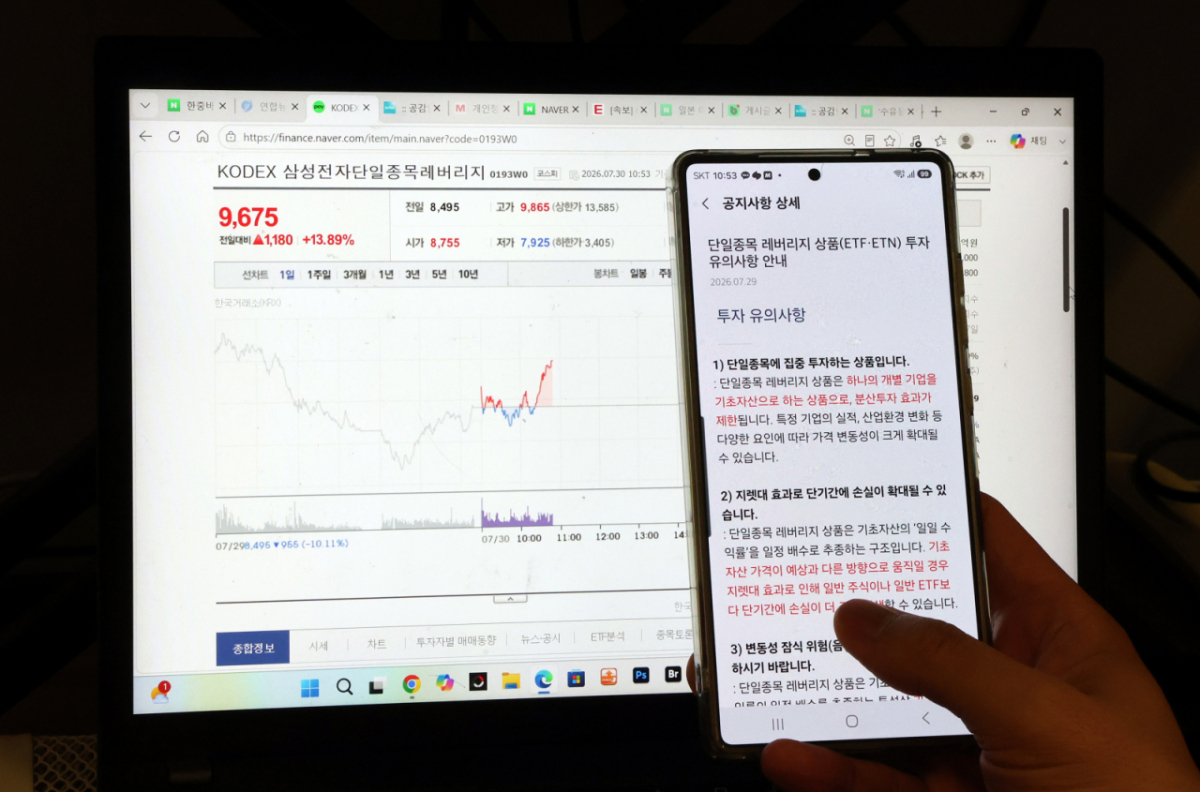
Financial authorities have decided to impose "punitive-style" transaction costs on investors frequently trading single-stock leverage ETFs. Measures will also be implemented to set upper limits on the proportion of single-stock leverage ETFs in each investor's securities account. Additionally, amendments to the Capital Markets Act are being pursued to allow flexible adjustment of leverage multipliers similar to Hong Kong. The implementation timing and specific measures will be decided through consultations among relevant institutional investors.
The Financial Services Commission announced on the 30th that these additional measures would be implemented based on its "Additional Measures for Single-Stock Leverage Products Explanation Document."
To prevent investors from buying and selling single-stock leverage ETFs multiple times within a day, additional transaction costs will be imposed. Detailed plans regarding the scope of application, methods, and rates will be finalized through discussions between relevant institutional investors and industry stakeholders.
The approach is expected to resemble the excessive order burden fee levied in derivatives markets for low market contribution and overly aggressive quoting. This serves as a de facto punitive charge against ultra-short-term trading, aiming to mitigate issues where investors excessively inflate market quotes and trading activity.
Total volume management per securities account will also be implemented. The Financial Services Commission has instructed each securities firm to set investment limits for single-stock leverage ETFs per account. Details such as the percentage limit of total investment amount, whether both domestic and foreign stocks are included in the investment amount, and how credit financing and unsettled transactions are calculated will be determined through autonomous discussions between relevant institutional investors and industry stakeholders.
Financial authorities have also decided to pursue amendments to the Capital Markets Act to allow flexible adjustment of leverage multipliers for market stability. This benchmarks Hong Kong's SFC (Securities and Futures Commission) variable leverage guidelines. The Hong Kong SFC released guidelines on the 24th permitting asset management companies to adjust leverage and inverse ETF multipliers based on their operational capabilities.
According to Hong Kong SFC guidelines, asset managers can maintain +2x and -2x upper limits while adjusting leverage ratios daily. Target leverage ratios for the next trading day must be disclosed via websites after market close each trading day, allowing flexible ratio adjustments. This aims to prevent excessive rebalancing required to match underlying asset returns and instill in investors the awareness that "holding beyond one day is risky."
Authorities will also mandate simulated trading for single-stock leverage ETFs. The scope of mandatory simulated trading and timing details will be finalized through discussions between stock exchanges and industry stakeholders. A Financial Services Commission official stated, "We will promptly prepare detailed plans centered on relevant institutional investors for each major task and implement them as early as possible."
Starting tomorrow (31st), the basic collateral requirement for single-stock leverage ETFs will be raised from 10 million won to 30 million won. Consequently, both new and existing investors must have 30 million won in cash deposits to purchase (additional) ETFs. Substitute securities and proceeds from sales before settlement completion (prior to T+2 days) will not count toward collateral requirements. Margin loans against sale proceeds are also excluded from collateral calculations.

 in STOCK
