

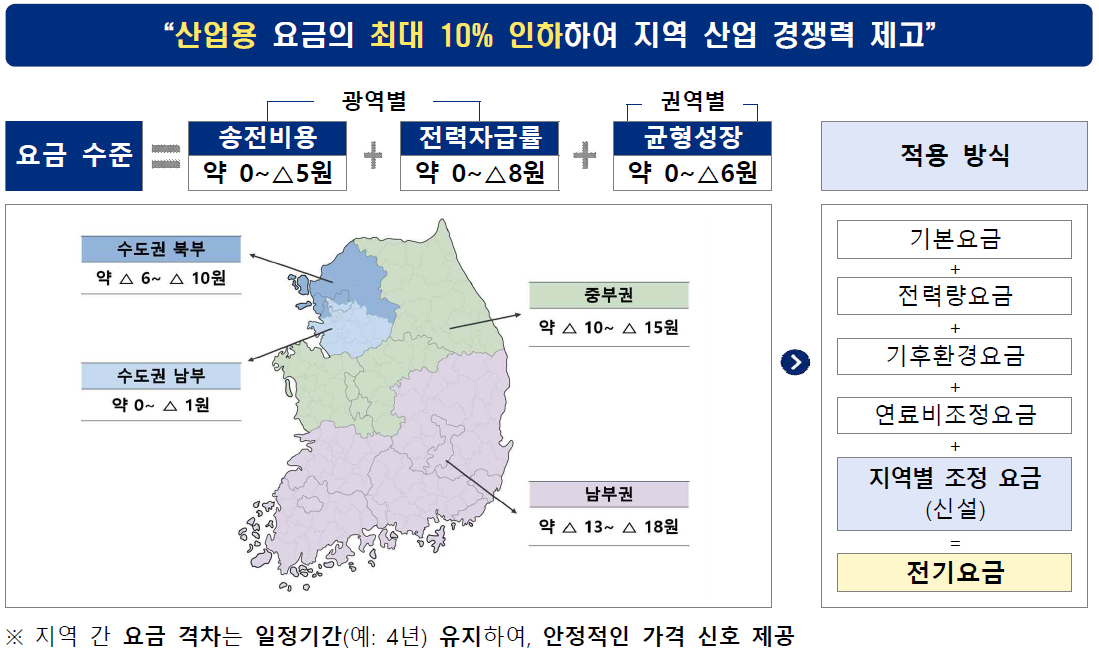
The government will reduce electricity rates in the Yeongnam and Honam regions by up to 10% through a reform of industrial electricity pricing. The country will be divided into four metropolitan areas, with larger rate reductions applied to regions farther from the capital area. Analysts expect this move to attract corporate investment to areas with lower electricity costs and generate annual savings of approximately 2.8 trillion won in electricity bills.
The Ministry of Climate, Energy and Environment and Korea Electric Power Corporation (KEPCO) held a public hearing on the 26th and unveiled the draft plan for the 'Industrial Regional Electricity Rate System' (hereinafter referred to as the regional rate system).
The regional rate system is a new pricing structure that reflects transmission costs and other factors in electricity rates, applying lower rates to regions closer to power generation areas. Previously, identical electricity rates were applied across all regions regardless of location. However, concerns have consistently been raised about rising transmission costs and declining grid operational efficiency due to concentrated power demand in the capital area while power generation facilities are primarily located in regional areas.
In response, the government decided to introduce a regional rate system that reflects transmission costs and market prices by region. The regional rate system will apply only to industrial use; residential users will continue under the current progressive pricing structure.
Currently, electricity rates are calculated by adding power usage charges, climate-environment charges, and fuel adjustment fees to basic charges. Under this reform, a regional adjustment fee will be added for industrial users. This regional adjustment fee will reflect factors such as transmission costs, power self-sufficiency rates, and balanced growth.
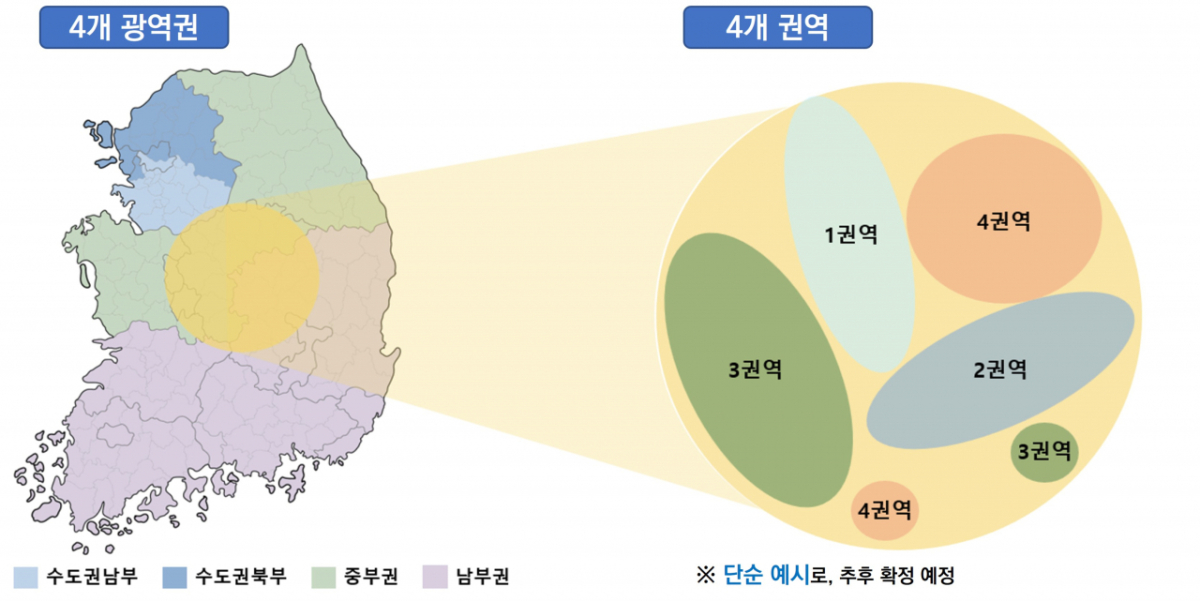
By region, areas will be classified into four metropolitan zones reflecting the power grid structure and four zones considering balanced growth, which are then combined to create a total of 11 designated regions. The four metropolitan zones include: Northern Capital Area (Seoul Gangbuk, Incheon, Northern Gyeonggi), Southern Capital Area (Seoul Gangnam, Southern Gyeonggi), Central Region (Chungbuk, Chungnam, Gangwon), and Southern Region (Gyeongbuk, Gyeongnam, Jeonbuk, Jeonnam). Jeju Island was excluded from the scope of this regional rate system due to its unique characteristics as an island region and special power supply-demand conditions.
The four zones will be ultimately defined by comprehensively considering industrial factors such as industrial crisis areas alongside the local preference index developed by the Ministry of the Interior and Safety. Electricity rates will vary depending on specific sub-zones within each metropolitan zone.
The rate reduction per kWh (kilowatt-hour) reflecting regional adjustment fees is: Northern Capital Area 6–10 won, Southern Capital Area 0–1 won, Central Region 10–15 won, and Southern Region 13–18 won.
The largest rate reductions are expected in the Southern Region, where renewable energy and nuclear power plants are concentrated. Considering last year's average industrial electricity sales price of 181.9 won per kWh, a maximum reduction of 10% is anticipated. Conversely, the Southern Capital Area, which has dense power demand such as the Yongin semiconductor cluster, saw minimal rate reductions. This aims to disperse concentrated power demand in specific regions through price differences between areas.
The Ministry of Climate, Energy and Environment analyzed that the introduction of this system will reduce industrial electricity bill burdens by approximately 2.8 trillion won annually.
Given that industrial power accounts for 51% of total power consumption, concerns have been raised about increased financial burden on Korea Electric Power Corporation (KEPCO) due to reduced industrial electricity rates. In response, the Ministry of Climate, Energy and Environment and KEPCO plan to minimize KEPCO's financial impact through measures such as introducing a regional pricing system for the electricity market (wholesale) and providing government fiscal support.
Once the system is fully implemented, it is expected to alleviate regional imbalances in power supply and demand while increasing incentives for corporate investment in regional areas. The government aims to introduce the system within this year and plans to proceed with follow-up procedures including official notifications and revisions to electricity rate regulations.
Kim Sung-hwan Gi Hu-bu (Minister) stated, "The introduction of the industrial regional electricity rate system is a core component of reforming the electricity pricing structure for mutual prosperity between Korea Electric Power Corporation and the industrial sector." He added, "By attracting investments from power-intensive industries to non-capital regions, we can reduce the national burden of building transmission networks and further enhance national balanced development and the long-term competitiveness of our industry."

 in ECONOMY

