

With time deposits at the five major banks surpassing 1,000 trillion won for the first time in history, capital flows toward safe-haven assets are expanding beyond deposits to include dollars and gold. Analysts say that as stock market volatility has intensified, investors have paused investments in risky assets such as stocks and are redirecting funds into bank deposits, dollars, and gold—a phenomenon known as "reverse money movement."
According to the banking sector on the 25th, demand for safe-haven assets has increased since the second half of this year, while demand for investment assets has declined. Following the milestone where time deposits at the five major banks (KB Kookmin, Shinhan, Hana, Woori, and NH NongHyup Bank) exceeded 1,000 trillion won, handling of traditional safe-haven assets such as dollars and gold has also risen.
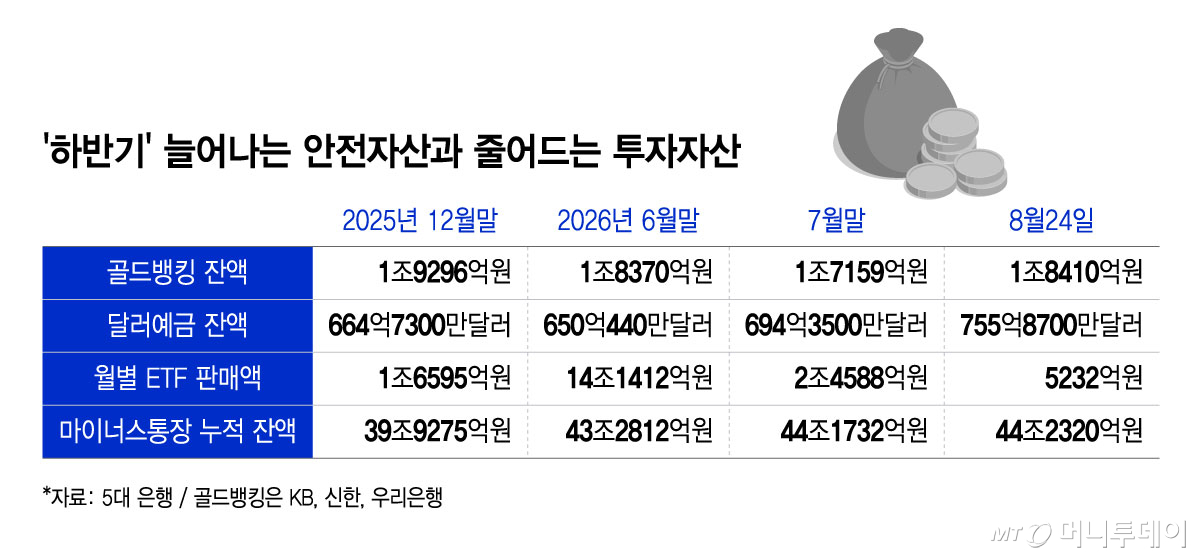
The balance of dollar-denominated time deposits at the five major banks increased by $6.152 billion from $69.435 billion at the end of last month to $75.587 billion on the 24th. Compared to $65.044 billion at the end of June, this represents a rise of $10.5826 billion in just two months—a trend sharply contrasting with the decline seen during the first half of the year from $66.473 billion at the end of last year.
This trend is also evident in gold. The balance of gold banking accounts at the five major banks fell from 19.296 trillion won at the end of last year to 18.370 trillion won at the end of June and further down to 17.159 trillion won at the end of July. However, it rose to 18.410 trillion won on the 24th, increasing by 125.1 billion won in less than a month.
"Given the high market volatility and inflation, this is a period where we must pay attention to safe-haven assets from a medium- to long-term perspective," said Jung Sun-mi, a senior advisor at KB Gold & Wise The First Ban Po-sen-teo (Team Lead). "Having experienced such a significant downturn, idle funds have moved into principal-guaranteed products like deposits, while demand for dollars and gold as hedge assets has remained steady."
Indicators related to investment assets have shown a noticeable slowdown in growth. Sales of ETFs (exchange-traded funds) at the five major banks plummeted from 14.1412 trillion won in June to 2.4588 trillion won in July, and reached only 523.2 billion won by the 24th of this month—just one-fifth of July's total sales. The negative loan account balance, which had increased by more than 3 trillion won during the first half of the year, rose by only 58.8 billion won from 44.1732 trillion won at the end of July to 44.2320 trillion won on the 24th of this month.
The financial sector diagnoses that as stock market volatility has expanded, investors are either cashing out portions of their existing investment assets or postponing additional investments in the stock market, while seeking alternative means to preserve funds through deposits or generate returns elsewhere.
"Due to recent significant stock market volatility, retail investors who have been disappointed are moving their funds into deposits," said Park Hyung-jung, an economist at Woori Bank. "Demand for gold is also rising amid growing market uncertainty driven by stock market instability and increases in bond yields."
Corporate funds are also flowing rapidly into the banking sector. In particular, it has been identified that companies with strong export performance in the first half of the year, such as semiconductor firms, have begun depositing large amounts into time deposits starting in July. Additionally, securities firms that recorded massive profits during the first half of the year are showing signs of increasing their bank deposits as the second half begins.
A banking sector official stated, "Corporate surplus funds find it difficult to actively engage in investments or foreign currency management due to expanded exchange rate volatility, leading to a demand for holding them in won-denominated time deposits while monitoring future market conditions." The official added, "At the same time, deposits from securities firm affiliates are also rising rapidly."
The financial sector believes that changes in time deposit balances could shift quickly depending on stock market conditions and other factors in the second half of the year. Jung Sung-jin, deputy center manager of KB Kookmin Bank's Gangnam Star PB Center, said, "With time deposit interest rates reaching the high 3% range, there is a movement to settle complex assets and take a break." He added, "Many investors are returning to safe-haven assets with the expectation that they can move back into riskier investments once market conditions improve."

 in FINANCE
