

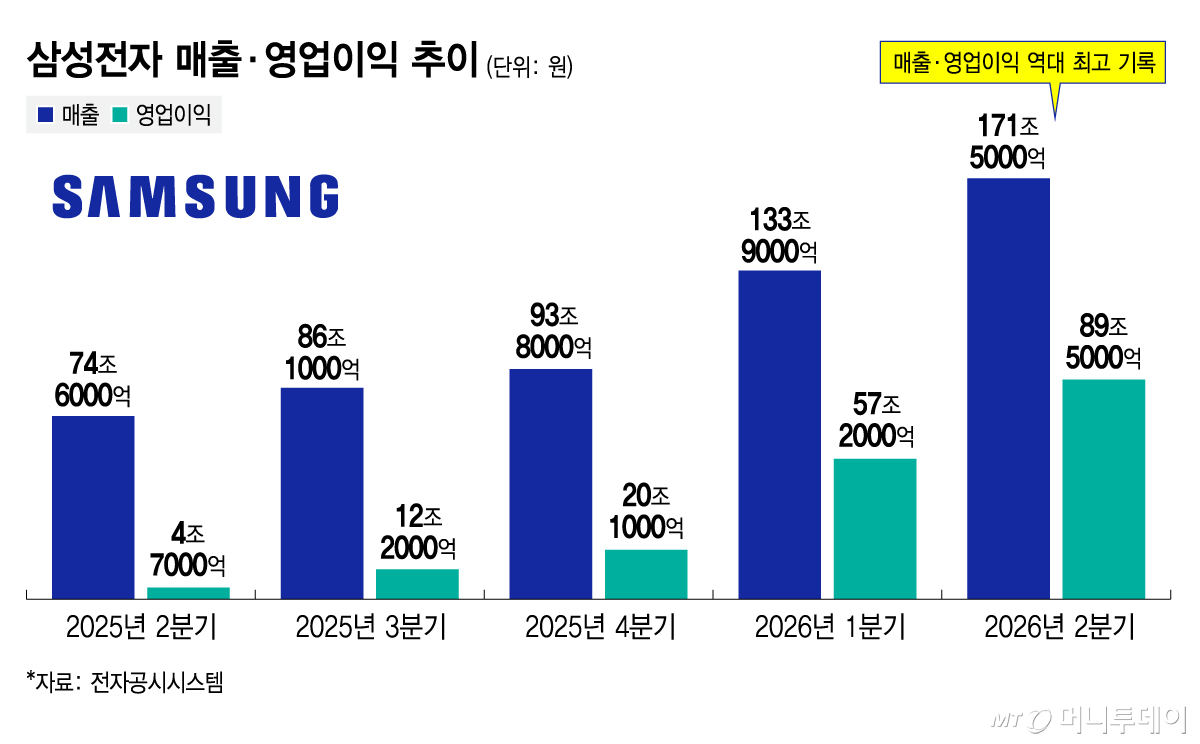
Samsung Electronics shattered another record for the highest-ever earnings. Contrary to market fears revealed by stock price plunges, semiconductor demand is expected to grow further, with profitability set to increase even more.
On the 30th, Samsung Electronics announced that it achieved second-quarter revenue of 171 trillion 499.5 billion won and operating profit of 89 trillion 492.4 billion won. Compared to the same period last year, revenue surged by 130%, while operating profit skyrocketed by 1,813.8%. For three consecutive quarters, both revenue and operating profit have broken all-time records.
Combined with SK Hynix, which reported its results the previous day, South Korea's memory semiconductor (hereinafter "memory") duopoly generated a total of 244 trillion 878.1 billion won in the first half of this year alone. On a per-quarter basis, that amounts to earning 1 trillion 648.7 billion won daily.
Operating profit was largely driven by the memory business segment. The Device Solutions (DS) division, which oversees semiconductors, reported revenue of 127 trillion 500 billion won and operating profit of 89 trillion 200 billion won. Of this, the memory business segment's operating profit margin is estimated to approach 80%, placing it on par with SK Hynix (76.3%) and Micron (80.4%) as one of the world's highest.
However, the finished products division, which took a direct hit from rising costs due to sharp increases in memory prices, recorded its first-ever quarterly loss in history. The Device Experience (DX) division performed well, achieving "the first time revenue exceeded 100 trillion won in the first half," but suffered an operating loss of 800 billion won due to deteriorating profitability. The Mobile Experience (MX) business unit, which manufactures smartphones, reported a loss of 700 billion won, while the TV and Home Appliances division posted a loss of 100 billion won. Subsidiaries Samsung Display and Harman each achieved operating profits of 700 billion won and 400 billion won, respectively.
The outlook for the second half is bright. First, the phenomenon of "unable to sell due to shortages" in memory is expected to intensify. On this day, during its management briefing, Samsung Electronics stated that it has already signed or is in the final stages of negotiating Long-Term Agreements (LTAs) with at least 10 global Big Tech companies, with a minimum term of five years. Chip demand is surging, yet supply expansion until 2028 remains difficult, leading to a growing number of customers seeking long-term contracts. A Samsung Electronics representative emphasized, "We can fully meet 60% to 70% of our planned capacity through multi-year contract volumes." Advance payments, which function as deposits, have already been received.
Most notably, demand is now pouring into foundry (semiconductor contract manufacturing), a segment that has consistently posted losses. In response, Samsung Electronics plans to begin construction of its second Taylor Fab in Texas, USA, by the end of this year, with Yangsan as the target for 2030. A Samsung Electronics official expressed confidence, stating, "A return to profitability is expected within a short period." The DX division also aims to enhance profitability through expanded sales of new products such as the Galaxy Z8 series, business diversification, and strengthening new ventures like robotics.

 in INDUSTRY
