

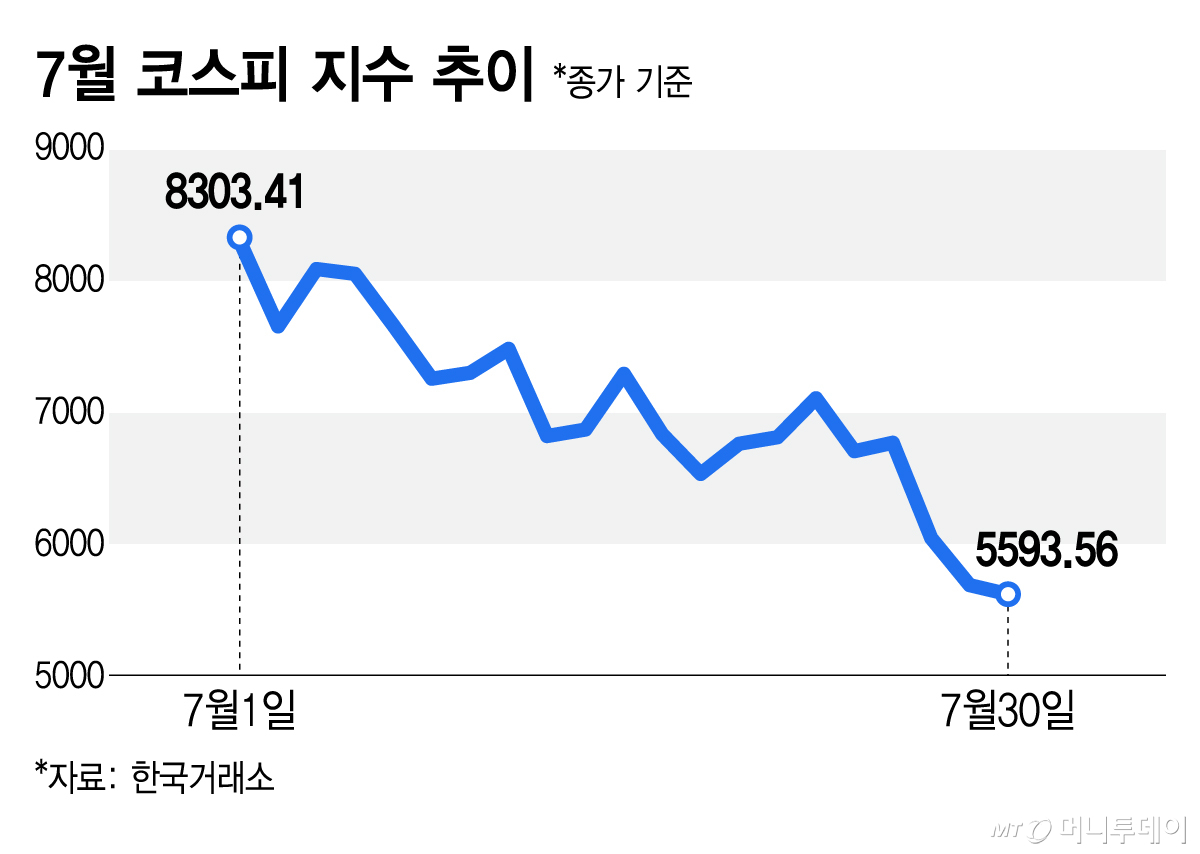
The KOSPI fell by 34.01% since the start of July. The index, which was above 8,300 at the beginning of the month, has dropped to below 5,500. This decline occurred amid intensifying concentration in semiconductor stocks and single-stock leveraged ETFs (exchange-traded funds), alongside rising concerns over U.S. base rate hikes, profitability worries related to artificial intelligence (AI), and growing geopolitical uncertainties. However, as the market has reached an undervalued phase, expectations are emerging that conditions may improve starting next month.
On the 30th, the KOSPI closed at 5,593.56, down 69.68 points (1.23%) from the previous trading day. Having triggered circuit breakers for two consecutive days since the 28th and plummeting by 16.17%, the KOSPI continued its downward trend on this day as well. Although heavy buying at low prices pushed the index up more than 5% during the session, attempting to recover above the 6,000 mark, it fell again in the afternoon. The market continued to show high volatility and an unstable trajectory.
Lee Kyung-min, head of the FICC Research Division at Daishin Securities, stated, "We estimate that supply-demand volatility centered on the semiconductor sector has not yet stabilized," adding, "The domestic stock market turned bearish again, giving up its previous gains."
Macroeconomic conditions were also negative. Overnight, the Federal Reserve System (Federal Reserve·Fed) decided to keep the base rate unchanged at its July FOMC (Federal Open Market Committee) meeting. However, the market interpreted the Fed's decision as signaling a high likelihood of future rate hikes, leading to a decline in U.S. stock markets.
In the KOSPI market, retail investors sold net 1.425 trillion won worth of stocks. Foreign investors and institutional investors bought net 1.3389 trillion won and 66.4 billion won worth of stocks, respectively.
Once again, declines in semiconductor stocks dragged down the KOSPI. Among KOSPI sectors, electrical and electronics fell by 3.08%, while medical and precision instruments dropped by 2.1%. Manufacturing, entertainment and culture, construction, and others slipped more than 1%. All of the top four companies by market capitalization declined. SK Hynix and SK Square fell by 5.64% and 6%, respectively. Samsung Electronics closed roughly flat. Samsung Electronics' stock fell 1.56%. Samsung Electric plummeted 14.58%. It appears that selling pressure emerged after Samsung Electric announced second-quarter earnings that exceeded market expectations.
Experts point to concentration in semiconductor stocks and single-stock leveraged ETFs as the main causes of this month's sharp KOSPI decline. Amid these conditions, big tech companies such as Alphabet (Google) and Meta recorded cash flows and EPS (earnings per share) below market expectations due to AI capital expenditures (CAPEX). Growth in China's semiconductor sector also negatively impacted investor sentiment.
However, securities firms believe the recent KOSPI decline has been excessive. The growth trends of Samsung Electronics and SK Hynix continue, and their current PER (price-to-earnings ratio) stands at historically low levels of 4 to 5 times relative to earnings.
Jo Soo-hong, head of the Research Division at NH Investment & Securities, analyzed, "While we cannot completely rule out the possibility that macroeconomic conditions or semiconductor industry trends may develop in a somewhat unfavorable direction, significant price adjustments accompanied by volatility driven by supply-demand factors have already progressed to a considerable extent."
Furthermore, there are expectations that the issue of single-stock leveraged ETFs, identified as a major cause of the KOSPI crash, will be partially resolved starting next month. Jo Jae-woon, a researcher at Daishin Securities, stated, "The period when liquidation pressure from leveraged ETFs meaningfully eases is expected to occur in about three to four weeks at the current pace," adding, "Measures by financial authorities are accelerating this timeline."
Experts advise investors not to sell out of panic but to observe the situation closely. Lee Jae-won, a researcher at Yuanta Securities, said, "If July was 'the month of fear,' next month is likely to be one where excessive fear normalizes," and added, "Moving forward, strategies should focus on calmly approaching semiconductor stocks with confirmed earnings and growth stocks that have fallen excessively, rather than abandoning leading stocks out of panic."
The KOSDAQ closed at 644.78, down 17.9 points (2.7%) from the previous trading day. The KOSDAQ also fell for three consecutive days. Among the top companies by market capitalization on the KOSDAQ, Jungsung Engineering (-15.33%), PSK (-11.75%), Pharmascience (-11%), and Peptron (-10.72%) all dropped more than 10%. In contrast, EcoPro and EcoPro BM rose by around 4%, while Samcheondang Pharmaceutical gained 2.68%.
On this day, the won/dollar exchange rate closed at 1,437.4 won for the week, down 9.3 won from the previous day's closing price.

 in STOCK
