

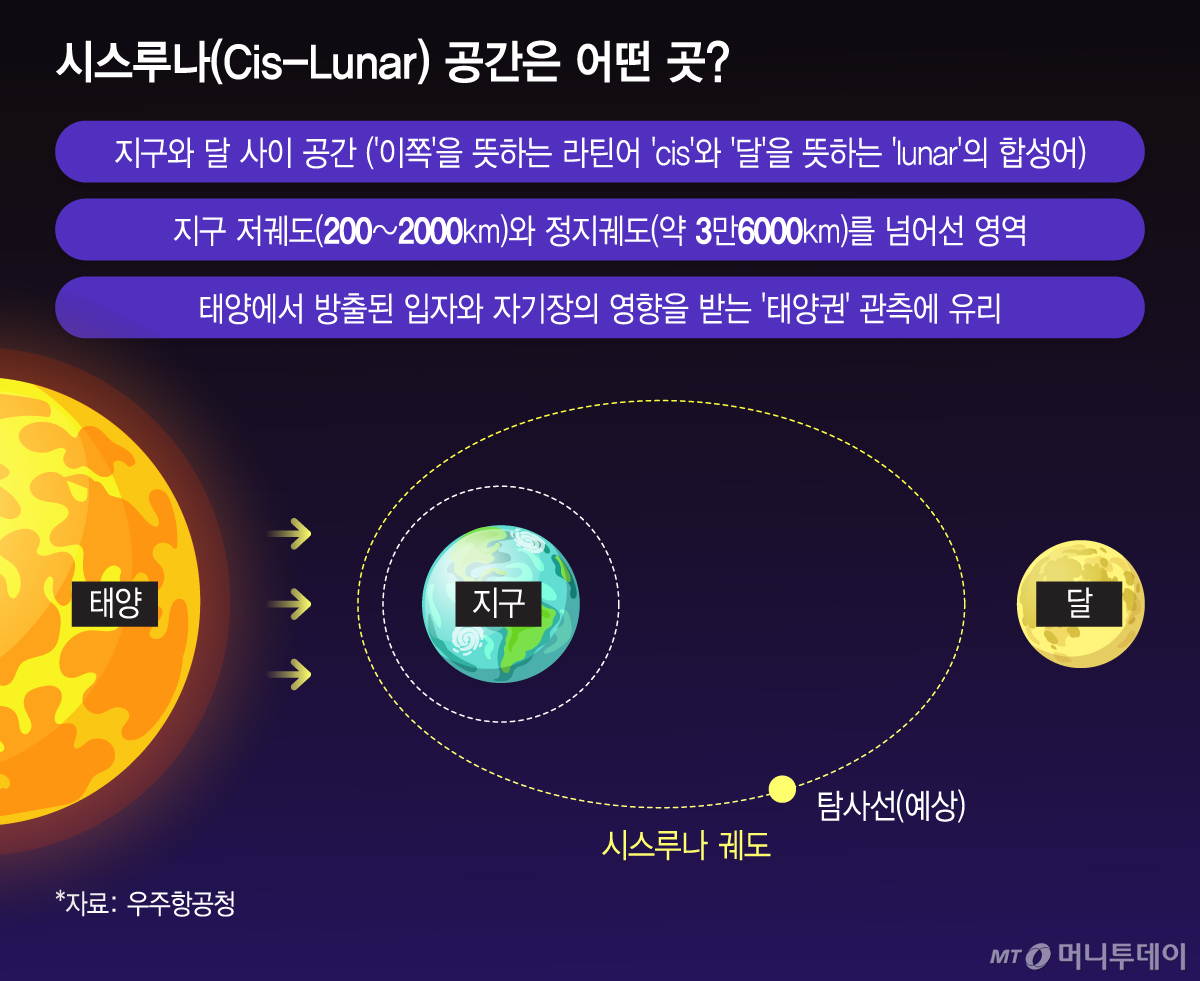
South Korea's space exploration plan shifts its focus toward goals that can be achieved closer and sooner. Before heading to the 'Lagrange Point 4' (L4), located about 150 million kilometers away in a decade, South Korea will first send an exploration spacecraft to the Cis-Lunar space between Earth and the Moon, approximately 380,000 kilometers away, by 2031.
According to the aerospace industry on the 18th, the Korea Aerospace Administration (KASA) is keeping the L4 exploration plan as a long-term task while focusing immediately on developing Cis-Lunar exploration spacecraft. The goal is to begin development in 2028 and launch in 2031. KASA is also exploring options for joint observation with overseas space institutional investors.
KASA first unveiled this plan at the COSPAR 2026 academic conference held earlier this month in Florence, Italy. The 'Earth-Moon Science Exploration Spacecraft' envisioned by KASA aims to test satellite technologies and observational capabilities required to observe solar activity from a side perspective. Ultimately, this is a preparatory step toward advancing to 'OSEL' exploration, which will allow for three-dimensional observation of solar activity by moving away from the straight line connecting the Sun and Earth.
The first destination is Cis-Lunar space. Cis-Lunar refers to the space between Earth and the Moon and its surrounding areas. This region contains orbits that allow relatively stable flight by utilizing the gravitational forces of both Earth and the Moon.
It can also serve as a communication hub connecting Earth and the Moon. Exploration spacecraft orbiting close to the Moon lose communication with Earth when they move behind the Moon. However, from certain orbits in Cis-Lunar space, it is possible to observe both Earth and the Moon simultaneously and relay communications for lunar exploration spacecraft.
KASA is particularly focusing on the field of space environment observation. The Sun continuously emits high-energy particles known as 'solar wind.' When strong particles reach Earth due to events such as sunspot explosions, they can disrupt the magnetic field, causing damage to communications, power grids, and aviation operations.
Solar wind can also be observed from low Earth orbit or geostationary orbit. However, because Earth's magnetic field blocks some of the solar wind particles, it is difficult to accurately measure their original state. In Cis-Lunar space, solar wind and magnetic fields can be observed in a relatively undistorted condition.
It is also advantageous for studying the 'magnetotail,' an elongated magnetic field region extending far into Earth's opposite side. The magnetotail is where energy accumulated from solar wind is stored and released. Direct observation at this location is necessary to predict the effects of space weather, but relevant data are scarce globally.
When KASA was first established, its flagship project was the L4 exploration spacecraft, which was not included in KASA's new projects for 2027. L4 is a point where the gravitational forces of the Sun and Earth balance each other, and South Korea aimed to conduct the world's first exploration there. After failing to pass the preliminary feasibility study last year and preparing for another attempt, KASA adjusted its schedule to align with rapidly changing international space development trends centered on lunar exploration and lunar base construction.
The plan is to accumulate observation technologies and spacecraft operation experience in Cis-Lunar space before advancing further to the more distant L4. Kang Kyung-in, head of KASA's Space Science Exploration Division, stated, "In the long term, data obtained from Cis-Lunar space will be essential information for international Lagrange point exploration," adding, "Now is the time to rapidly enhance South Korea's space observation capabilities and accumulate independent exploration experience."
KASA also plans to develop equipment such as cameras for photographing the Sun from a distance and magnetometers and plasma analyzers for directly measuring magnetic fields and high-energy particles on-site. Additionally, KASA is promoting the launch of a 700-kilogram-class small lunar exploration spacecraft led by private companies in 2030. If both the Cis-Lunar exploration spacecraft and the private lunar exploration spacecraft are launched as planned, South Korea will simultaneously begin lunar orbit exploration and space environment observation.

 in TECH
