

"Students often judge materials as authentic if the sentences are smooth or the image quality is high. There is a tendency to trust photos and videos without question more than text, and they may even judge a video as recent based solely on view counts and comment reactions." (A high school teacher in Gyeonggi Province)
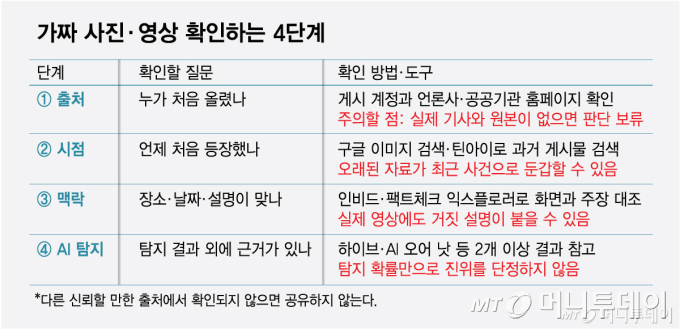
When filtering out fake information, one should not start by looking for awkward fingers or characters on the screen. As generative AI performance improves, errors visible to the naked eye are decreasing. Content that attaches false explanations to real photos or alters only a person's statements is also difficult to detect with AI-generated content detectors. The verification order recommended by fact-checkers including Google, InVID-WeVerify (which aids fact-checking), and AI industry experts consists of four steps: 1) Source verification, 2) Tracking the time of distribution, 3) Context confirmation, and 4) Utilizing AI detectors.
The first step is to verify the source. One must check whether the account that originally posted the material is the original photographer or the person who made the statement, or if it was reposted by a media outlet or public institutional investors. Even if it says "foreign media report" or "expert statement," one must open the actual article and original text directly. If it involves a celebrity's statement, find their official account, interview transcript, or original video to check the context before and after.
The second step is tracking the time of distribution. By entering a photo into Google Image Search or TinEye, one can verify whether the same or similar image was posted in the past. However, there is no guarantee that the oldest material among search results is the original post or the date of photography. The posting date of the relevant account must be cross-referenced with media reports from that time.
The third step is context confirmation. Videos can have key scenes extracted using InVID-WeVerify and reverse-searched individually. One also checks whether signs, buildings, vehicles, and weather in the screen match the location and date claimed by the post. Claims or phrases can be checked against already verified content in Google's "Fact Check Explorer." Even real videos can become misinformation if they are attached with explanations of other events.
AI detectors such as HYBE AI Detector (Hive AI detector) and AI or Not serve as the final auxiliary tool. The probability presented by a detector is not evidence that confirms truth or falsehood but rather a statistical estimate based on training data. In May this year, NewsGuard, a U.S.-based private media trust rating agency, created 45 versions of 15 real photos—including originals, lightly edited versions, and heavily manipulated versions—and tested five AI detectors. Only 10 cases had consistent judgments from all five tools. The rate at which photos with only brightness and background adjustments were judged as AI-generated varied by tool, ranging from 27% to 93%.
Even if "99% probability of AI generation" appears, one must not conclude that the entire photo is fake. Conversely, a low probability does not make an actual photo real. Asking a chatbot about truthfulness is also not verification. Even if a chatbot cites media outlets or research institutional investors as sources, the actual address and content must be verified.
Verification habits that teenagers should learn include: 1) Directly searching links and institutional investor names provided by AI, 2) Cross-verifying with at least two independent sources, and 3) Reverse-searching the time and location of photo/video photography. Entering a photo into an AI detector is the final step after going through these processes.
The "AI Basic Act" implemented last January requires labeling results created by generative AI. However, if labels are removed or deleted during reposting, users may find it difficult to verify them. There are concerns that platforms should maintain production and editing histories in reposted content and restrict the recommendation and monetization of content with unclear sources.

 in TECH
