

If the National Pension Fund had maintained its stock holdings unchanged since the end of May, it is estimated that the valuation of its domestic stocks would have decreased by over 180 trillion won due to a recent sharp decline in stock prices. As of the end of May, the total size of the National Pension Fund's reserves stood at 1,848 trillion 702 billion won, representing a 26.8% increase compared to the end of the previous year. Thanks to a surge in the KOSPI, the fund's investment return rate from the beginning of the year through the end of May reached 26.18% (amount-weighted return). However, following a subsequent sharp market downturn, a significant portion of the previously recorded gains has been reversed.
The National Pension Fund's Investment Management Division announced on the 30th the "May 2026 End-of-Month National Pension Fund Investment Return Rate" report. By asset class, domestic stocks posted the highest return at 106.76%. This was followed by foreign stocks at 16.13%, alternative investments at 7.70%, foreign bonds at 5.80%, and short-term funds at 2.03%. Domestic bonds were the only asset class to record a loss, with a return of -2.42%.
The National Pension Fund explained that despite geopolitical risks in the Middle East, the stock market rose due to strong fundamentals centered on semiconductors driven by demand for AI (artificial intelligence). The domestic stock market (KOSPI) rose 101.13% compared to the beginning of the year, while global stock markets excluding Korea (MSCI ACWI ex-Korea, in U.S. dollars) increased by 10.22%.
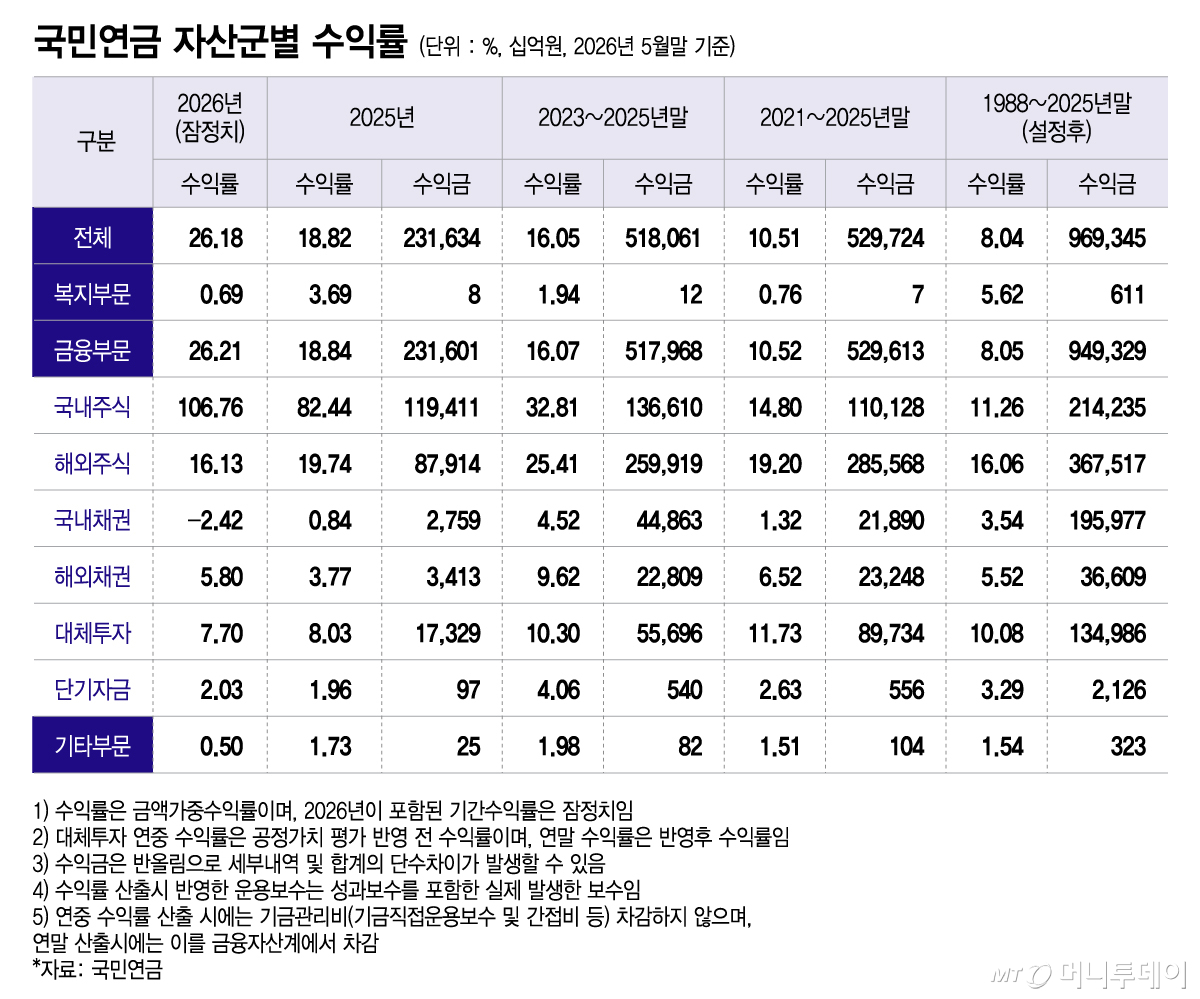
Domestic bonds suffered losses as rising oil prices fueled inflation concerns, leading to higher interest rates and a decline in bond valuation values. The yield on three-year government bonds rose by 0.77 percentage points compared to the beginning of the year. Foreign bonds maintained positive returns despite rising interest rates, supported by factors such as currency appreciation. Alternative investments reflected the first-quarter fair value assessment, incorporating increases in the value of held assets like infrastructure and private equity, along with interest and dividend income.
As of the end of May, asset valuations were as follows: domestic stocks 543 trillion 635 billion won (29.4% share), foreign stocks 650 trillion 679 billion won (35.2%), domestic bonds 289 trillion 571 billion won (15.7%), alternative investments 254 trillion 478 billion won (13.8%), and foreign bonds 106 trillion 967 billion won (5.8%).
![[Santiago=NEWSIS] Reporter Kim Jin-a = President Lee Jae-myung is seen delivering remarks at a compatriot dinner meeting held at a hotel in Santiago, Chile, on the 29th (local time). July 30, 2026. bluesoda@newsis.com /Photo=Kim Jin-a](https://thumb.mt.co.kr/cdn-cgi/image/f=avif/21/2026/07/2026073016194160615_2.jpg)
The KOSPI fell by 2,882.59 points (34.0%), closing at 5,593.56 on the 30th of this month from a closing price of 8,476.15 on May 29. Assuming the National Pension Fund maintained its stock holdings unchanged since the end of May and applying the KOSPI decline rate directly, it is estimated that the valuation of domestic stocks would have dropped from 543 trillion 635 billion won to approximately 358 trillion 700 billion won—a decrease of about 185 trillion won. However, this is a projection based on the assumption that the fund's stock portfolio composition matches the index exactly.
The National Pension Fund does not disclose in real time the proportion or status of its domestic stock holdings. Additionally, starting this month, the National Pension Fund has resumed rebalancing (asset reallocation) for domestic stocks. In connection with this, market observers had speculated that a large volume of sell orders triggered by the fund's rebalancing would enter the market. However, Kim Sung-ju, President of the National Pension Service Lee (President), denied so-called "sell bomb" rumors on social media (SNS) on the 1st, stating, "Even if the National Pension Fund proceeds with rebalancing, the possibility of it becoming a 'bomb' is zero."
Kim Lee (President) added, "Moreover, last month the Investment Committee changed the rebalancing rules to implement them gradually over an extended period." According to the Korea Exchange, pension funds and other institutional investors made net purchases totaling 826.2 billion won cumulatively this month. Pension fund transaction figures include various pension funds such as the National Pension Fund and mutual aid associations. Given that the National Pension Fund is the largest institutional investor in Korea, supply-demand indicators from pension funds are regarded by the market as signals reflecting the trading trends of the National Pension Fund.

 in STOCK


